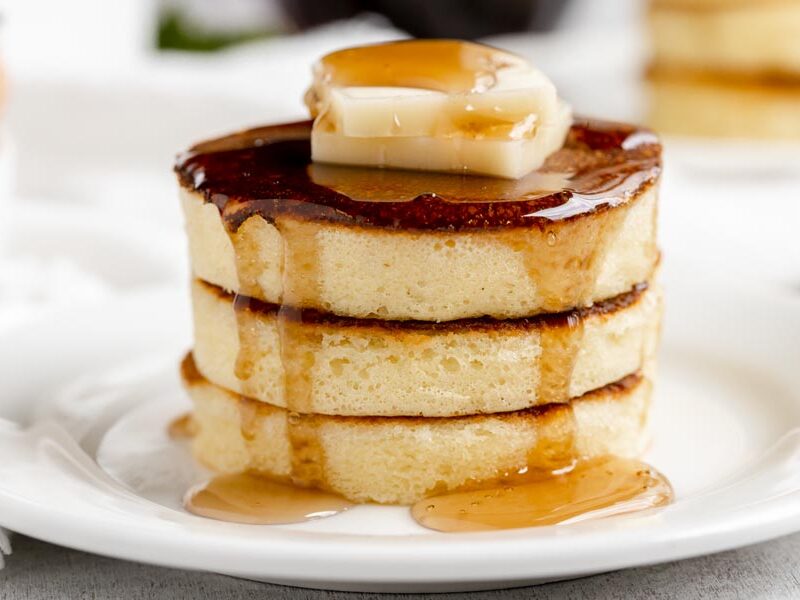
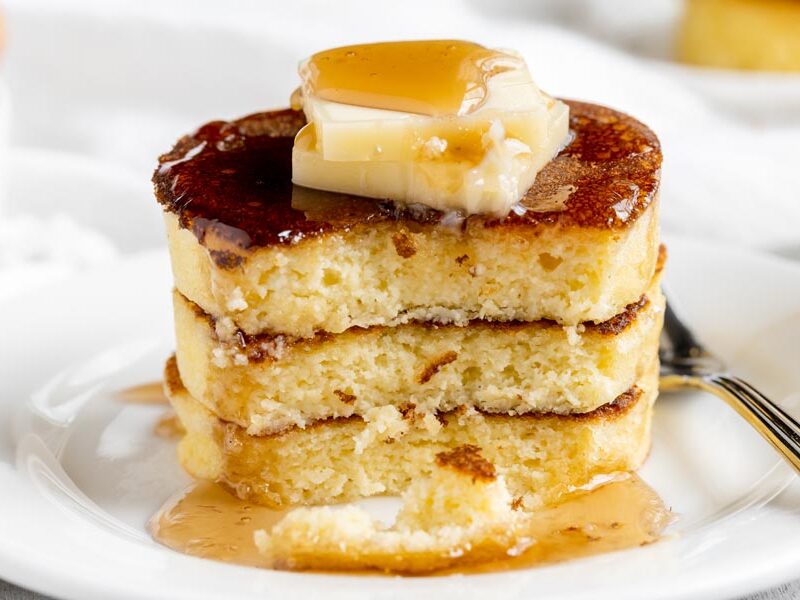
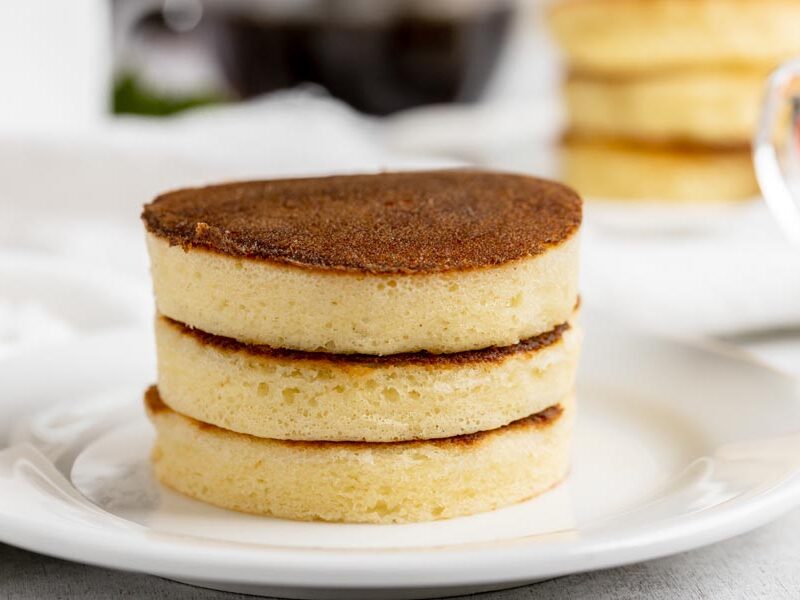
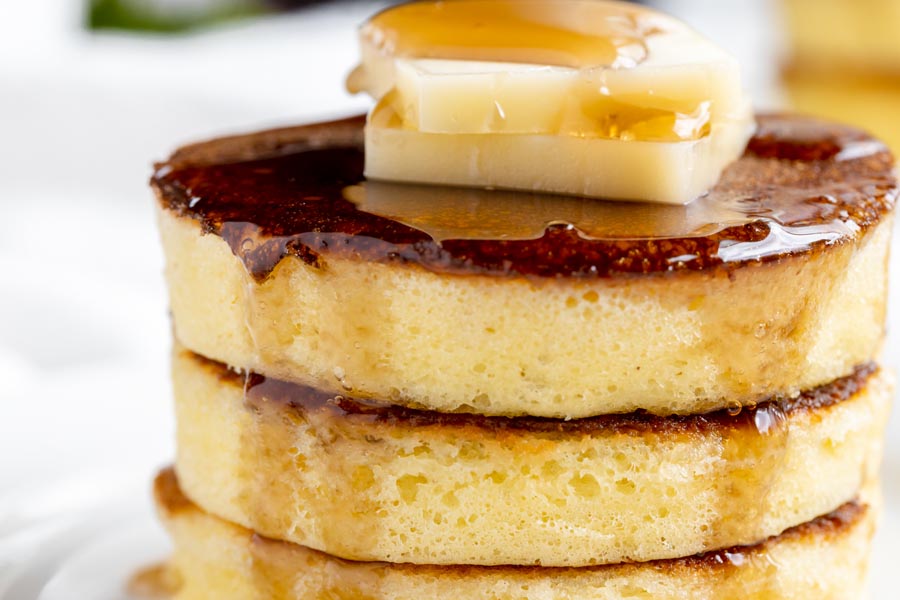
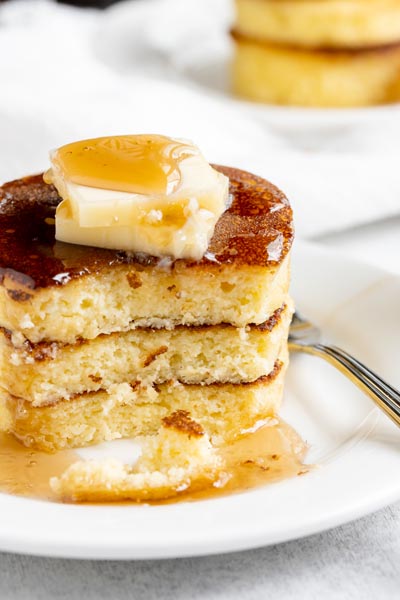
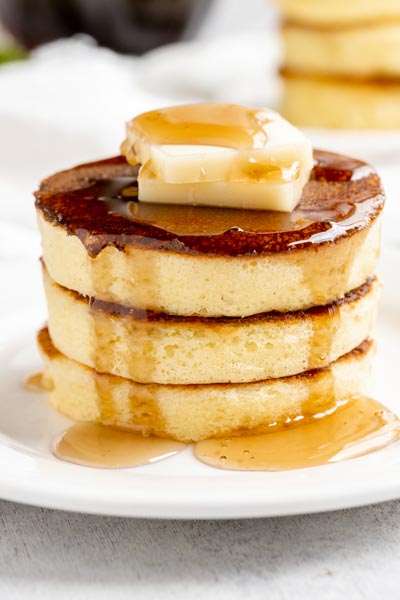
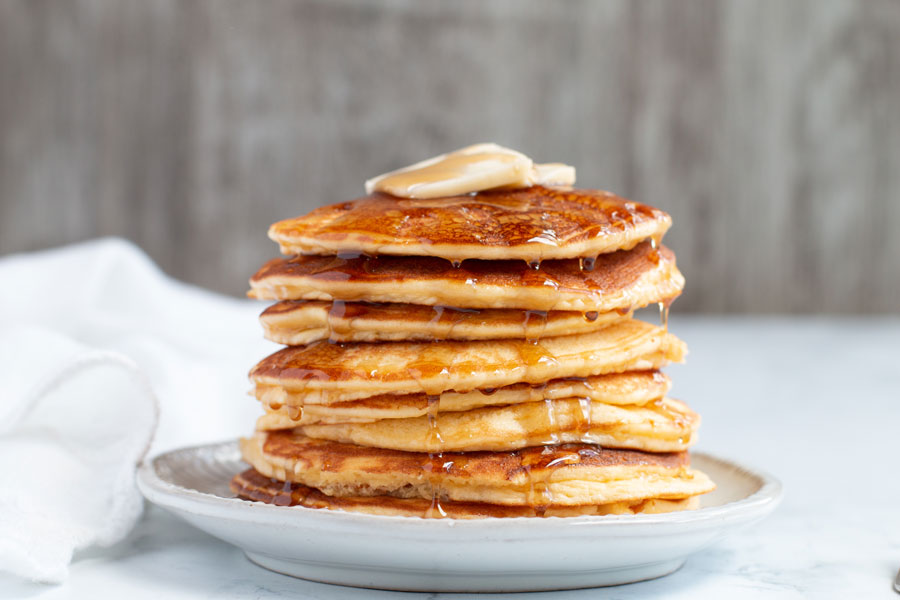
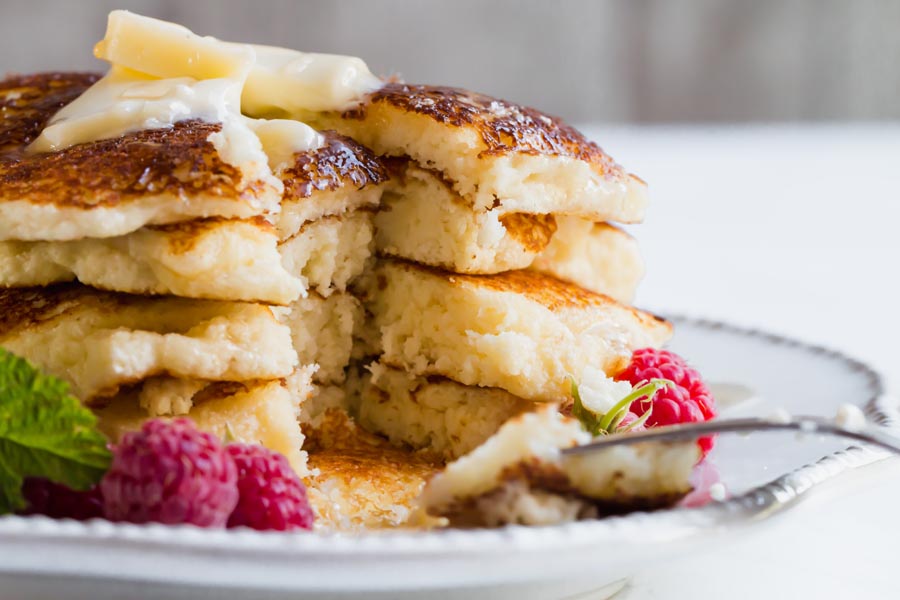
These keto soufflé pancakes puff up thick, spongy, and over an inch tall, just like the real thing at only 1.2g net carbs each. A biscuit ring is my trick for that towering rise.
Lazy weekend mornings need pancakes. That's why I have so many versions on this site, from my everyday almond flour pancakes and chocolate pancakes to chai-spiced ones. They all taste good, but none of them gave me what I really wanted: a tall, thick stack that actually looks like it came off a diner griddle.
Most keto pancakes spread thin because there's no gluten holding the batter in place. I accepted flat flapjacks for years until I started using a biscuit cutter as a ring mold. You grease the ring, set it on the griddle, pour the batter inside, and cover it with a lid. The trapped steam and contained batter force the pancakes to rise up instead of spreading out. Mine come out over an inch tall, every time. The edges get a light crisp while the center stays soft and spongy, which is exactly the texture you want for soaking up syrup.
The idea comes from Japanese pancakes, which use whipped egg whites folded into batter to create that jiggly, towering height you see all over social media. I tried the meringue approach in my kitchen and it works, but it's a whole production: separating eggs, whipping whites to stiff peaks, folding gently so you don't deflate everything. My version puts all the ingredients in a blender. Whole eggs, cream cheese, coconut flour, and baking powder do the work. Same height. A fraction of the effort.
I tested this recipe with almond flour first and didn't love the result. The pancakes tasted too eggy and the almond flour scorched at the low heat you need for a slow, even cook. Coconut flour fixed both problems. It absorbs more liquid, gives the batter better body, and the cream cheese neutralizes any coconut flavor so you'd never guess it's in there. I've gotten messages from people who swear they hate coconut flour but couldn't detect it in these.
One reader, Rhonda, put it better than I could: she'd made dozens of pancake recipes and they were all thin and eggy. These were the first ones that actually looked like pancakes to her. She went back for a second plate, which she said she hadn't done with a breakfast recipe in months. That's the kind of reaction that tells me the biscuit ring method is worth the extra step.
If you want to mix up your mornings, my French toast is another weekend favorite, and pancake pies are great when you want something you can grab with one hand. But for the full stack experience (butter pooling, sugar free maple syrup running down the sides), this is the recipe I reach for. Fair warning: if you're doubling the batch, you'll need more rings or plan on cooking in three shifts.
What are Japanese soufflé pancakes?
Japanese pancakes are the thick, jiggly stacks that blew up on social media a few years back. The traditional method separates egg whites from yolks, whips the whites into a stiff meringue, then folds that meringue into the batter. That careful folding is what gives them their signature bounce and wobble.
I tried the meringue method and it works, but it felt like too many steps for a Saturday morning. So I built a simpler version that gets the same height without separating a single egg. The trick is the biscuit ring mold combined with a covered griddle, which traps steam and lets the batter puff up inside the ring. You lose a little of that jiggly wobble, but you get a low carb pancake that’s just as tall and about half the work.
Flour substitutions
The most common question I get is whether the coconut flour can be swapped out. I get it, but you really can’t taste coconut in these. The combination of cream cheese and eggs completely masks it.
If you still want to try almond flour, use 1 1/4 to 1 1/2 cups instead of the 1/2 cup of coconut flour. I’ve done this swap and the pancakes turned out fine, but two things to watch: almond flour burns faster at low heat, so keep your griddle temp even lower than you think, and the texture leans slightly more eggy. My almond flour pancakes use a different ratio that’s built for that flour, so if almond is your preference, you might like that recipe better.
Storage and reheating
Store leftover pancakes in an airtight container in the fridge for 4-5 days. I stack mine with a small piece of parchment between each one so they don’t fuse together.
You can freeze them for about a month. The texture changes slightly after freezing (they lose a bit of the spongy bounce), but they’re still solid pancakes. I freeze mine in a single layer on a sheet pan first, then transfer to a freezer bag so they don’t become one giant pancake brick. If you’re stocking up on keto breakfasts for the week, these batch well alongside my breakfast bowls for variety.
Skip the microwave for reheating. I’ve tried it and they come out rubbery and deflated every time. A skillet over medium-low heat for about 2 minutes per side is my go-to, or a toaster oven at 350 for 3-4 minutes. They won’t be quite as puffy as fresh, but the skillet method keeps the outside lightly crisp and the inside spongy.
How to make the fluffiest pancakes
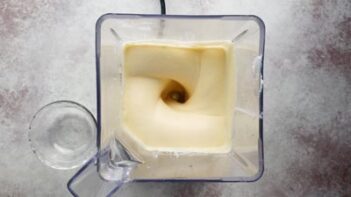
Add your ingredients to a blender: cream cheese, eggs, heavy cream or nut milk, coconut flour, sweetener, baking powder, and vanilla.
Blend until smooth. I use a blender over a hand mixer because the cream cheese breaks down completely and you get a much smoother batter.
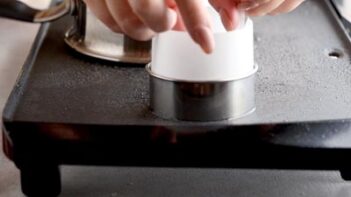
Preheat your griddle to low heat. Spray with cooking oil. Grease the inside of each biscuit cutter with cooking spray and line with a strip of parchment paper. Place the rings on the griddle.
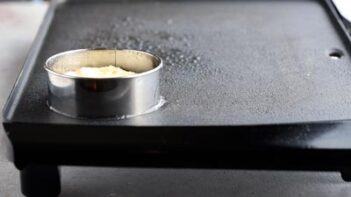
Pour batter into each ring about halfway up. Cover with a pot lid or dome-shaped cover and cook for 8-10 minutes until the top looks set.
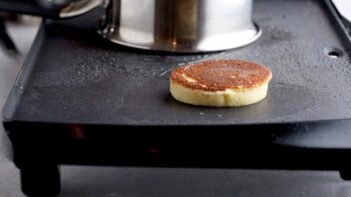
Flip with the ring still on. The batter is thick enough to hold its shape. Let cook 30-60 seconds on the second side, then slide the ring off.
Key ingredients and equipment
Cream cheese provides moisture and neutralizes the eggy flavor that plagues most egg-heavy keto batters. I've made batches without it and the difference is obvious.
Eggs build the protein structure. Without gluten, these pancakes need eggs to rise and hold together.
Coconut flour is my pick over almond flour for this recipe. I tested both head-to-head: almond flour burned at the low heat required and produced a taste I didn't want. Coconut flour absorbs more liquid and gives the batter real body.
Sweetener for flavor, though you can leave it out entirely.
Heavy cream or nut milk thins the batter to the right consistency. I use heavy cream for richness, but almond milk or macadamia nut milk work for a lighter version.
Baking powder is the second leavening agent alongside the eggs. Check your expiration date; old baking powder is the number one reason these don't puff.
Vanilla rounds out the flavor.
Griddle over a skillet. The heat distribution is more even, which matters when you're cooking at low temp for 10 minutes straight.
Biscuit cutters are the secret to the height. Without them, the batter spreads into regular flat pancakes.
To a blender or food processor, add cream cheese, eggs, coconut flour, sweetener, nut milk or heavy whipping cream, baking powder and vanilla. Blend or pulse until smooth.
2
Preheat griddle
Preheat griddle to low heat. Spray with cooking oil. Coat the inside of each biscuit cutter with cooking spray and line with a ring of parchment paper. Place on the griddle.
3
Add pancake batter
Scoop pancake batter into each ring. Add enough to fill about halfway up. Cover with a pot or dome shaped lid and let cook for 8-10 minutes.
4
Flip pancakes
Pancakes are ready to flip when the edges look set and the center looks matte with small bubbles. Keep the biscuit cutter on and flip the pancake and ring together. Cook for 30-60 seconds, then slide off the ring. Remove the pancake and repeat with the remaining batter.
Nutrition
Per serving: 1 2" pancake
Calories
74
Fat
5.6g
Protein
2.7g
Total carbs
2.3g
Net carbs
1.2g
Nutrition is an estimate calculated from the ingredients listed. Brands vary, so check labels if you track closely.
Frequently Asked Questions
Why didn't my pancakes puff up?
I've had flat batches too, and it comes down to four things. Your griddle was too hot (the outside sets before the batter can rise), you didn't cover the ring with a lid (the trapped steam is what creates the puff), your baking powder is old, or the batter sat too long before cooking. Baking powder starts working the moment it hits liquid, so I pour right after blending. I tried making the batter the night before once and the pancakes came out noticeably flatter. My workaround is to measure the dry ingredients the night before and blend everything fresh in the morning.
Can I make these dairy-free?
I haven't tested a fully dairy-free version of this specific recipe, but you could try swapping the cream cheese for a dairy-free alternative and using coconut cream or almond milk instead of heavy cream. The cream cheese is doing important work here (moisture and flavor masking), so just dropping it won't give you good results. If dairy-free is your main priority, my dairy-free chocolate chip muffins are a tested breakfast option I can stand behind.
What can I use instead of biscuit cutters?
Use another heat safe ring about 2 inches wide. A metal cookie cutter is the closest substitute for a biscuit cutter. Wider rings can work, but they will make fewer, larger pancakes, so the nutrition per pancake will change.
Can I make these without eggs?
I haven't found a way to make them work without eggs, and I've tried. The eggs provide the protein structure that holds the pancakes together and helps them rise, since there's no gluten doing that job. Flax eggs and commercial egg replacers couldn't create the same lift in my testing. Eggs are non-negotiable for this one.
Got an inch of height on my first try. Honestly wasn’t expecting that from what feels like more of a production than a Tuesday morning pancake run. Coconut flour batter is thicker than I’m used to but it goes smooth in the blender, no issues there.
Somewhere around month four of keto I just stopped thinking about pancakes. Not a conscious decision, more like the absence of a craving I’d stopped fighting. Coming back to them after almost a year was more confrontational than I expected, in a good way. The texture is genuinely different from everything else I’ve tried. That spongy interior from the cream cheese base is closer to what I remembered than I thought was achievable at 1.2 net carbs. The flip timing is finicky though. Edges need to look fully set before you move them or the center won’t hold, and it took me two tries to dial it in. But making a real breakfast on a Sunday morning and having it feel like something again, that’s the thing I didn’t think I was going to get back.
Two tries is fast for these. That edge-set rule is the whole key – edges fully opaque before you touch it, every time. Ana, you described the Sunday morning thing better than I ever have.
Confession: ‘low heat’ means something different on my stove. First batch came out completely flat. Turned it down another notch and suddenly these were doing exactly what they’re supposed to, the height is almost cartoonishly satisfying for 1.2g net carbs.
The heat thing trips everyone up on these. My first batches I kept thinking it was the batter, but too hot means the outside seals before anything can rise. ‘Cartoonishly satisfying’ is exactly the word, Tara.
Didn’t have nut milk so I used heavy cream, batter came out a lot thicker, which actually made the ring shapes easier to fill. Not sure if that’s intentional but it worked.
Heavy cream is already the alternate listed in the recipe, so you got there anyway. The thicker batter does help with the rings, it doesn’t slosh around before the lid goes on.
I’ve tried probably every keto pancake recipe out there and the biscuit ring trick is the first thing that’s actually given me real height. The texture here is also noticeably better than the almond flour versions I’ve been cycling through. Made these twice already this week.
Almost talked myself out of these. Wasn’t sure I could get the biscuit ring technique right. They puffed up though, and I stood there over the griddle kind of stunned. Texture is softer than I expected from coconut flour, almost spongy, which I liked. Four stars for now because mine deflated when I pulled the rings off, probably a timing issue. Is there a visual cue besides set edges that tells you they’re ready before the flip?
Look for the center going matte. Glossy means wet. When small bubbles form in the middle and the sheen disappears, that’s your window. Also, are you pulling the ring before you flip? Keep it on through the flip. Second side sets in about 30-60 seconds, then slide it off. That’s usually what deflates them.
My 7-year-old watched the rings fill up at the griddle going ‘they’re actually getting taller.’ When they came out she thought I’d snuck in real IHOP pancakes. Sunday morning regular from here on out.
Made these again this morning (fourth time now) and the way the batter puffs up inside the biscuit rings is SO satisfying to watch. Still can’t get over how thick they come out. Double batch next time.
My 8-year-old poked at them with his fork first like they were suspicious (fair, these do not look like regular pancakes). Then he asked if they were ‘the bouncy kind’ and could we please have them every Sunday now. The way the coconut flour makes them so thick and spongy is freaking wild, and now I have a standing breakfast request from a second grader. That’s a food endorsement I did not expect.