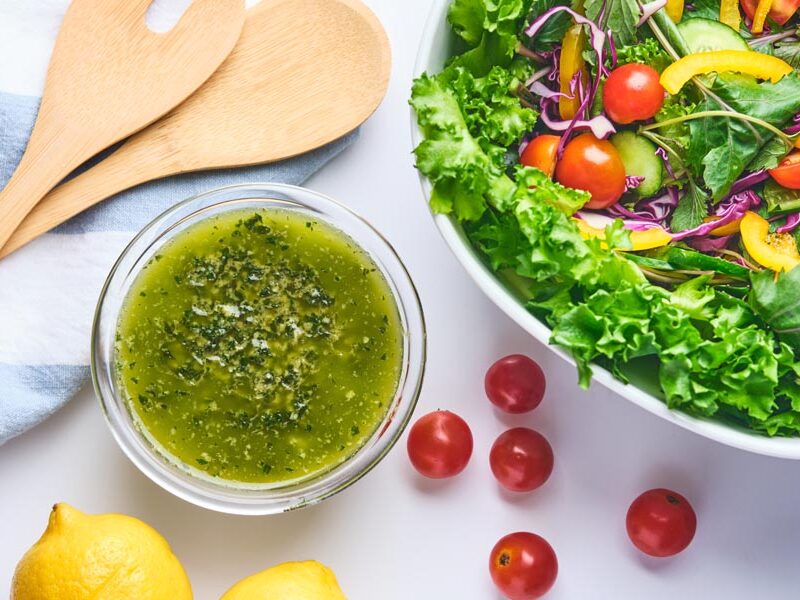
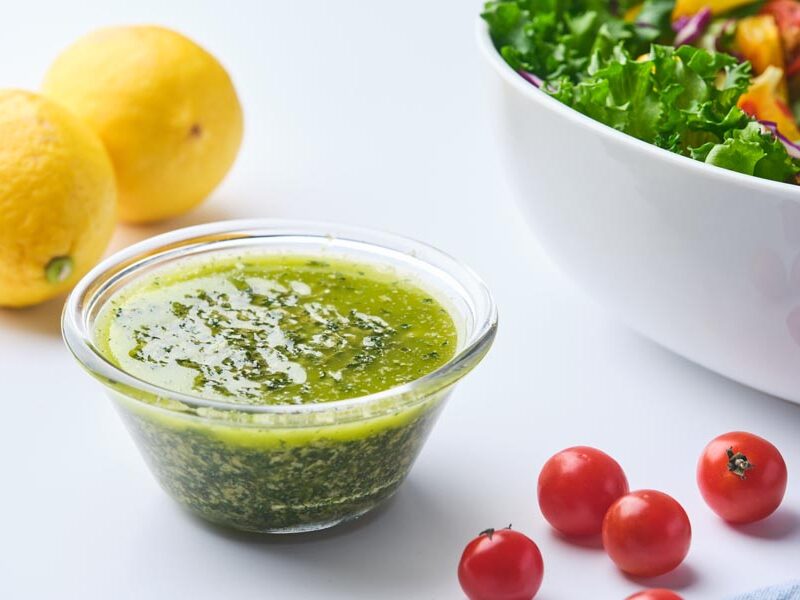
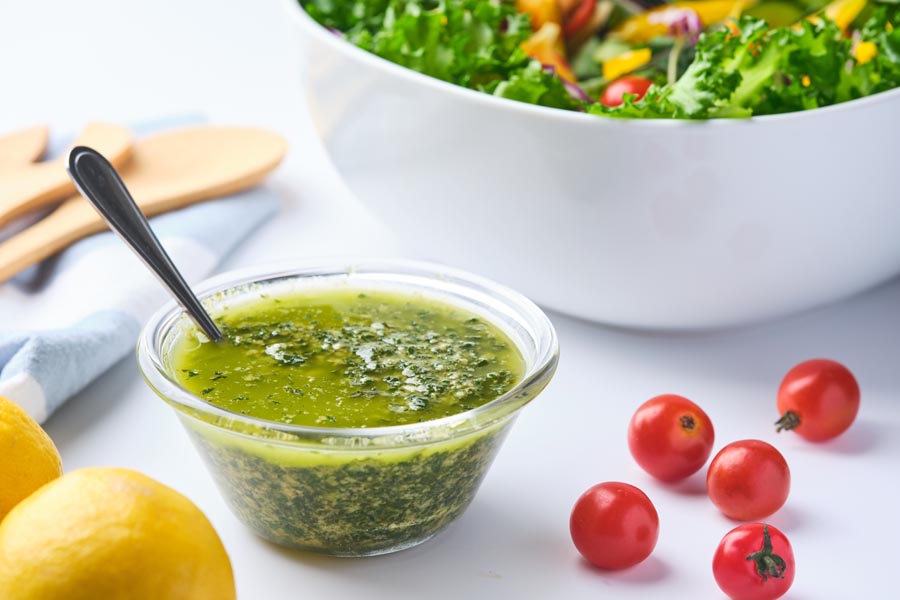
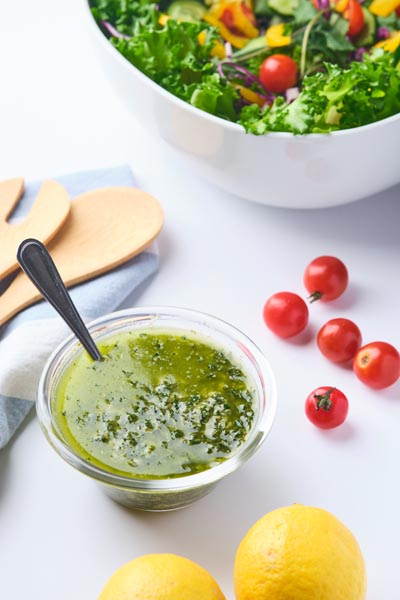
Bright, garlicky pesto salad dressing with fresh basil and parmesan — 0.7g net carbs, no sugar or seed oils. My specific ratio of lemon juice to olive oil makes this the vinaigrette I come back to every week.
I've been making this pesto vinaigrette for years, and the version here is the one I finally stopped tweaking. The difference came down to the lemon juice. Not a squeeze, not "to taste." The full quarter cup is what keeps this from turning into a thick paste that clings instead of coats. I figured that out after too many batches that looked beautiful in the food processor but sat on lettuce like a glob. The lemon thins it out, brightens the basil, and gives the whole thing a clean finish that makes you want another forkful. That ratio is deliberate, and it's the reason this works as a dressing and not just a sauce.
Pine nuts are listed but I skip them half the time. I've made this both ways side by side on arugula and can't tell the difference once the lemon and parmesan are in play. They add a subtle richness, but the basil and parmesan carry the flavor on their own. If pine nuts are running $12 at your grocery store (they are at mine), save your money and make it without.
The garlic is worth thinking about. I use 4 cloves because I like it garlic-forward, but if basil is what you want to taste, start with 2 cloves and work up. A reader named Lauren tried 4 her first batch and found it overpowering, then cut to 2 the second time and said the basil came through clearly. Both versions are good. It depends on whether you want the garlic to lead or the basil.
This is a keto dressing I actually reach for, not one I made once for the site and filed away. No sugar, no canola oil, no mystery emulsifiers. Just basil, parmesan, garlic, olive oil, and lemon. I keep a jar in the fridge most weeks and use it more than my creamy feta dressing or even a quick alfredo sauce when I need something fast on vegetables or grilled chicken.
If you want a creamier version, I cover that below. And if you're wondering whether store-bought pesto works as a shortcut, I answer that in the FAQs.
Creamy pesto dressing variation
If vinaigrettes aren’t your thing, I’ve turned this into a creamy low carb version and it’s just as versatile.
Whisk 1 1/2 tablespoons of mayonnaise into the finished dressing. That’s all it takes. The mayo adds body without dulling the basil. I’ve also tested it with a dollop of plain Greek yogurt, which makes it tangier and a little lighter. Sour cream works too if that’s what you have open. All three produce a creamy dressing that clings to greens instead of pooling at the bottom of the bowl.
Ways to use this dressing
On salads
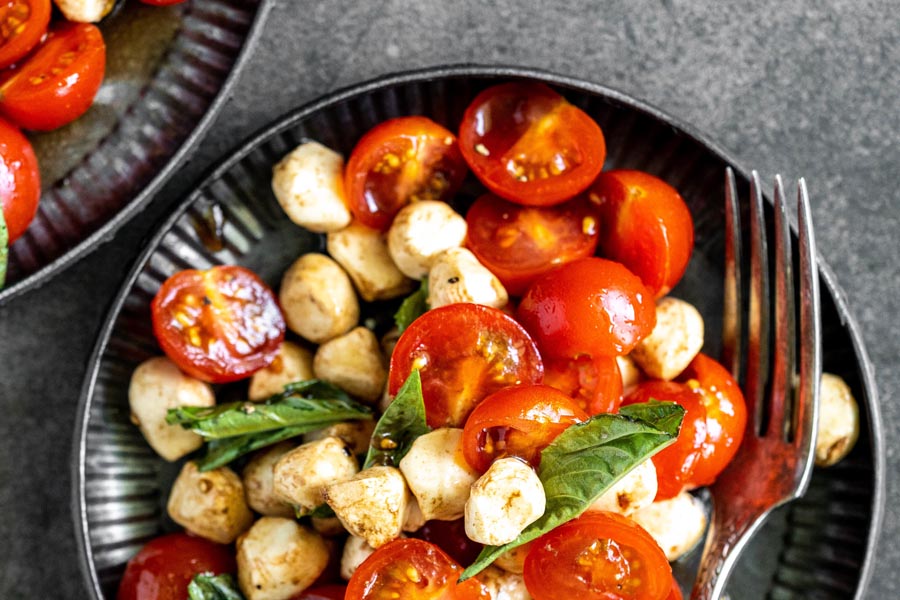
This is my default when I want something more interesting than plain olive oil and lemon on greens. I use it on arugula with shaved parmesan most often, but it works just as well on a caprese salad or drizzled over caprese bites as a finishing touch.
On roasted vegetables
Toss roasted or steamed vegetables with a few spoonfuls right when they come out of the oven. I do this with asparagus, broccoli, cauliflower, and zucchini regularly. The residual heat loosens the dressing and helps it coat everything evenly.
As a spread or sauce
Use less oil when blending and this works as a thicker spread. I’ve used it on pizza bowls as a base instead of tomato sauce, and it pairs well with stuffed Italian sausage as a finishing drizzle.
Pasta salad
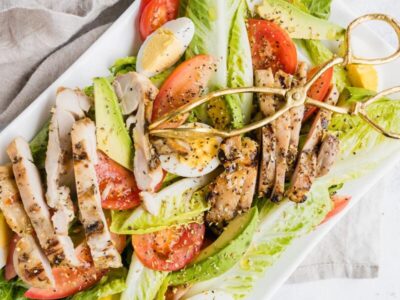
Toss low carb tuscan chicken pasta with cherry tomatoes, sliced olives, diced bell peppers, and this dressing. Chill for a few hours before serving. I make this for weekend lunches when I want something cold and filling.
How to store pesto dressing
Keep it in a mason jar or container with a tight lid. It stays good in the fridge for up to one week, and I’ve pushed it to 10 days without any issues when the jar was clean and sealed well.
One thing you’ll notice: the olive oil solidifies when cold. This is completely normal and actually a sign of good quality olive oil. The dressing will look thick and separated when you pull it out of the fridge. Let it sit on the counter for 10-15 minutes, then shake it well. It comes right back together. I leave mine out while I prep the rest of my salad and it’s pourable by the time I need it.
How to make pesto vinaigrette
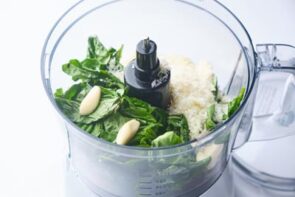
Blend fresh basil leaves, grated parmesan cheese, garlic, and pine nuts in a food processor or blender until finely chopped.
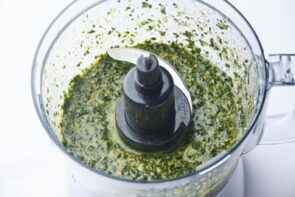
Slowly pour in olive oil while blending, then add lemon juice, salt, and pepper to taste.
Store in the refrigerator for up to one week and shake well before each use.
Key ingredients and substitutions
Basil leaves: Fresh basil is the star here. It brings a subtle sweet, peppery flavor with hints of mint and anise. I use packed cups (pressed firmly into the measuring cup, no air gaps) for a stronger basil presence. If you're out of fresh basil, parsley or cilantro work as substitutes but you'll get a different dressing entirely. I wouldn't call it pesto at that point.
Parmesan cheese: Freshly grated, not the pre-ground stuff. I've tried pecorino Romano in this dressing and it's sharper, almost too salty. Asiago is milder and works fine. For dairy-free, nutritional yeast gives you that umami depth without the cheese.
Garlic: Fresh cloves only. I use 4 because I like garlic to show up, but 2 cloves works better if you want basil to lead. Garlic powder (1 teaspoon) fills in if you're out of fresh, but the flavor sits flatter.
Pine nuts: I list these as optional because I mean it. I've made this keto dressing without them dozens of times and it holds up fine. Walnuts or almonds sub in well if you want some richness without the price tag.
Olive oil: My go-to for Italian-style dressings. Avocado oil works but tastes more neutral. I wouldn't use coconut oil here.
Lemon juice: This is the ingredient that turns pesto into a pourable dressing. The full quarter cup is deliberate. It keeps the texture light and the flavor bright. Red wine vinegar or white wine vinegar both work as substitutes, but the flavor shifts slightly. Apple cider vinegar is fine too.
In a food processor or blender, combine basil leaves, grated parmesan, garlic and pine nuts (if using). Pulse to combine until finely chopped.
For this step
1 cup packed fresh basil leaves
1/2 cup grated parmesan cheese
4 cloves garlic
2 tablespoon pine nuts, optional
2
Make it a dressing
With the food processor or blender running, slowly pour in olive oil. Add lemon juice, salt & pepper and pulse to combine. Store in a mason jar or dressing container. Shake well before use.
For this step
1/2 cup olive oil
1/4 cup lemon juice
1/4 teaspoon salt
1/4 teaspoon black pepper
Nutrition
Per serving: 2 tablespoons
Calories
149
Fat
15.3g
Protein
2.5g
Total carbs
0.8g
Net carbs
0.7g
Nutrition is an estimate calculated from the ingredients listed. Brands vary, so check labels if you track closely.
Frequently Asked Questions
What is the difference between packed and unpacked basil leaves?
Packed basil means I press the leaves firmly into the measuring cup with no air gaps. Unpacked is just dropping them in loosely. For this dressing, I always pack my basil. It gives you roughly twice the volume of leaves and a much stronger basil flavor. If you measure loosely, the dressing will taste more like garlic and olive oil than pesto.
Can I use store-bought pesto to make this faster?
I've done this when I didn't have fresh basil on hand. Mix about 3 tablespoons of jarred pesto with 1/4 cup olive oil and 2 tablespoons lemon juice, then whisk it together. You'll have a dressing in under a minute. It won't taste as bright as the from-scratch version (jarred pesto runs heavier on oil and salt), but I've used it in a pinch and it gets the job done.
Why did my pesto dressing solidify in the fridge?
That's the olive oil. It naturally solidifies at refrigerator temperatures, which is normal and actually a sign you're using real olive oil. I deal with this every time I make a batch. Just pull the jar out 10-15 minutes before you need it and give it a good shake. It loosens right back up. If you're impatient like I sometimes am, run the jar under warm water for a minute.
How long does homemade pesto dressing actually last?
I say one week to be safe, but I've used mine at 10 days with no change in flavor or smell. The lemon juice and olive oil both help preserve it. If the basil starts to brown or it smells off, toss it. I make a fresh batch most Sundays, so mine rarely sits that long anyway.
Can I make this dairy-free without parmesan?
I've made it with nutritional yeast instead of parmesan and it's surprisingly close. I use about 2 tablespoons of nutritional yeast in place of the half cup of cheese. You lose a little of the sharpness, but the umami flavor holds up. I actually prefer the nutritional yeast version on roasted vegetables where the milder flavor lets the veggies come through more.
Can I use vinegar instead of lemon juice?
I've swapped in red wine vinegar and white wine vinegar, and both work well. The flavor is a little sharper and less bright than lemon, but it still makes a great dressing. I use the same amount (1/4 cup). Apple cider vinegar works too, though it adds a slight sweetness I don't love with basil.
Can I make this without a food processor?
I've done it by hand when my food processor was buried in the back of the cabinet. Finely chop the basil, garlic, and pine nuts with a sharp knife, then whisk everything together with the oil and lemon juice in a bowl. The texture is chunkier, but it tastes the same. A mortar and pestle also works well if you want a smoother paste before adding the liquids.
Pecorino instead of the parmesan is worth trying, but you have to pull the salt back or it goes over the top. I left the quarter teaspoon out entirely and it was still plenty seasoned. Sharper than your version, and it still came out smooth from the slow oil pour. I put it on chicken more than salad at this point. Thanks.
Embarrassing admission: pesto was my Sunday thing before keto. When I switched I just quietly let it go. First time making this, the basil smell hit and it all came back before I’d even finished blending. Doesn’t taste like a substitute. Just tastes like pesto. Going to keep fresh basil on the counter just for this.
The basil smell just hits you before you’re even done blending. That’s the whole thing, honestly. I started growing a big pot on the windowsill because I make it so often.
Add the oil slowly while the blender’s running, don’t dump it all at once. Took me a few batches to stop rushing that part, but the difference in how it coats greens is real. On batch six now, weekly rotation. I’ve been using 3 tablespoons of lemon instead of the full quarter cup since it’s pretty sharp straight out of the blender, but that’s just me.
The slow pour really does show up in the coating, it’s not just technique theater. And the lemon settles after a day in the fridge, Michelle, if you ever want to try the full quarter cup.
Skip the pine nuts if you’re batching this weekly, parmesan handles it. Day four out of the fridge it’s actually stronger. The lemon. Still working out my garlic level but already doubling the batch.
Had a feeling four raw cloves would wreck it, so I wrapped the garlic in foil and roasted it first (375 for about 20 minutes, basically while I was doing other stuff). Completely different. Sweeter, kind of nutty, but the lemon still cuts through so it doesn’t go flat or heavy. Honestly thought roasted vs raw was a minor call. It wasn’t. I’m a total beginner and I was nervous about committing to what felt like a lot of garlic, and now I feel like I accidentally made a whole different dressing. Double batch last weekend, held in the fridge three days, still bright green. Worth roasting.
375 for 20 minutes is how I roast garlic for basically everything else, never tried it in this dressing. Reads as a different thing entirely. Raw cloves are doing the sharp punchy work in the original, so once you mellow them out the whole profile shifts. Three days still bright green tracks too, the lemon holds basil color longer than people expect. Going to do this next time garlic’s already in the oven.
My daughter tried to talk me into just using jarred pesto, then had two bowls of salad once I made this. The lemon ratio is noticeably brighter than anything bottled, which is probably why she stopped asking.
Never made homemade dressing before and started with this one because I had fresh basil doing nothing. The lemon + parmesan in the blender is SO good. Already made a second batch.
First homemade dressing and already on batch two, Paul. I always pack the basil into the cup when measuring, not just drop it in. Roughly doubles the leaf volume and you taste the difference.
Good call on the cucumbers. The lemon keeps it light enough to eat straight as a dip without feeling like you’re just drinking dressing. My kids do the same with bell pepper strips.
My teenager drowns everything in ranch and avoids anything that looks too green. Made this last week, tossed it with an arugula salad, and watched them reach for a second bowl before I even sat down. I think the lemon-to-oil ratio is what does it. Bright without being sharp. Already have a batch in the fridge.
Second bowl before you sat down. That’s a better review than anything I could write. Arugula is my favorite for this one, the bitterness holds up to the lemon instead of getting washed out.
Six batches in and I just figured something out. Skipped the pine nuts by accident last week and the lemon comes forward SO much cleaner without them. The parmesan already carries the body, I think the pine nuts were competing with it. This ratio is really something.
I’ve made this four times since I found it and it’s become my default salad dressing. Last week I was out of pine nuts and used it anyway, and the lemon-to-olive-oil ratio carries the whole thing without them. Still bright, still punchy, nothing was missing. The fresh basil is the part I won’t skip. I keep a double batch in the fridge now.
Made this twice now and both times I loved the flavor (that lemon-to-olive oil ratio really does make it taste brighter than store-bought), but both times it turned a noticeably darker green after sitting in the fridge overnight. First time I chalked it up to leaving it too long, but the second batch did the same thing within about 20 hours. I’m guessing it’s the basil oxidizing, but I want to fix it because the color makes it look kind of unappetizing even though it still tastes great. I’ve seen some people blanch the basil before making pesto to lock in the color, but I wasn’t sure if that would dull the fresh flavor here since the whole point seems to be keeping it bright and Italian-tasting. Is that worth trying, or is there another trick that works better for a dressing?
Blanching works but you lose some of that bright just-made flavor, which kind of defeats the point here. What I do is press plastic wrap directly against the surface of the dressing before putting the lid on. No air contact, no oxidation. Still darkens a little after a week but nothing like what you’re describing at 20 hours.
Tip I wish I’d known the first time: let it rest 10-15 minutes before you use it. The garlic mellows and the lemon goes from sharp to actually bright. I used it straight out of the blender my first batch and it was fine, then I left it to sit while I finished prepping dinner and came back to something completely different. Now I always make it first.
That lemon shift is real. Right out of the blender it’s sharp, give it 10 minutes and it actually opens up. I make it while everything else is prepping for that reason.
Every pesto dressing I’ve made ends up tasting like oil with a hint of green. The lemon ratio here is what changes that. Garlic and parmesan actually come through instead of disappearing into the fat.
Solid dressing. Made it twice now and the lemon really comes through on arugula. Pine nuts pull their weight even though they’re listed optional. My one note is the garlic. Four cloves in half a cup of olive oil hits sharp, first batch tasted more garlic than basil. Cut to two cloves the second time and the basil came through clearly. Still works at four if that’s your preference, but heads up if you’re sensitive to it.
Two cloves if you want the basil to lead, four if you want the garlic to. I like it punchy so I’ve kept four, but you figured out which side you’re on faster than most people do.
Wasn’t sure a pesto would work as a dressing without being too thick, but the lemon juice thins it out perfectly and it coats greens without weighing them down. Drizzled it over some arugula with shaved parmesan and I’m glad I trusted the process.