

Keto Yogurt

Annie Lampella @ Ketofocus

By Annie Lampella, Pharm.D.

Published February 9, 2023 • Updated March 9, 2026

This post may contain affiliate links. See my disclosure policy.

I make a fresh batch every single week. Three ingredients, an Instant Pot, and 8 hours of hands-off incubation for creamy, low carb yogurt that beats anything at the store.

This recipe isn’t just for homesteaders or DIY types. I started making my own yogurt in 2019 because I was tired of paying $2 per cup for store-bought keto options, and I haven’t bought store yogurt since. The plain base is only 3.5 g carbs per 5 oz serving, and from there you can flavor it however you want (strawberry, lemon, peach, cotton candy, whatever sounds good that week).


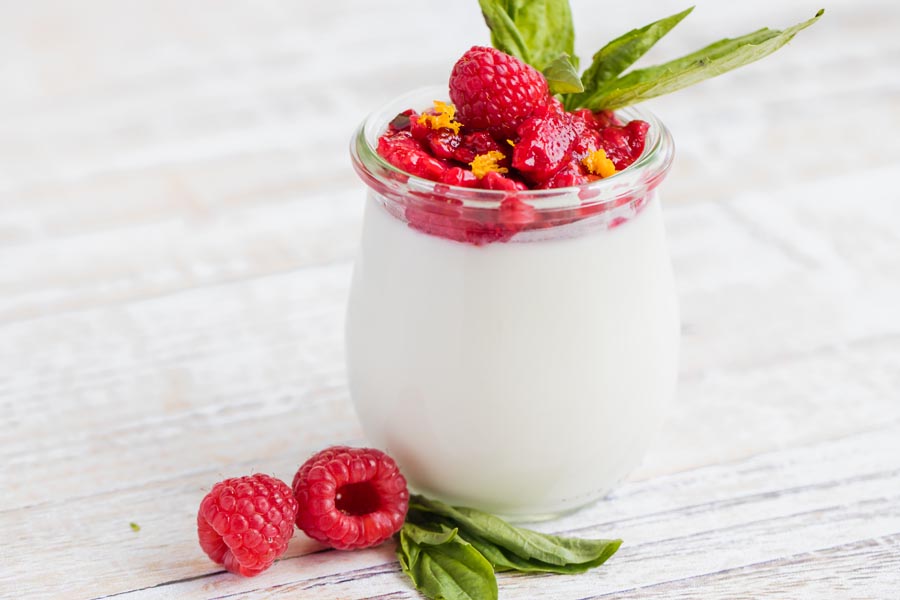
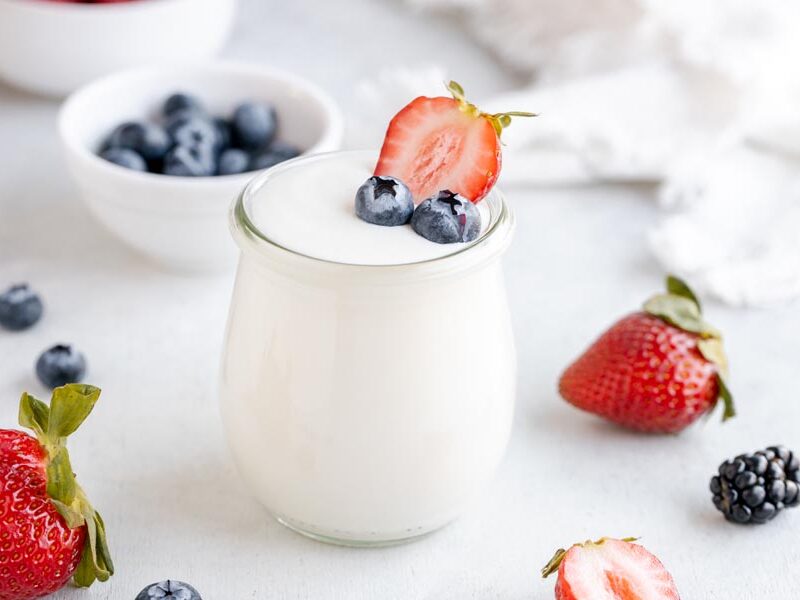
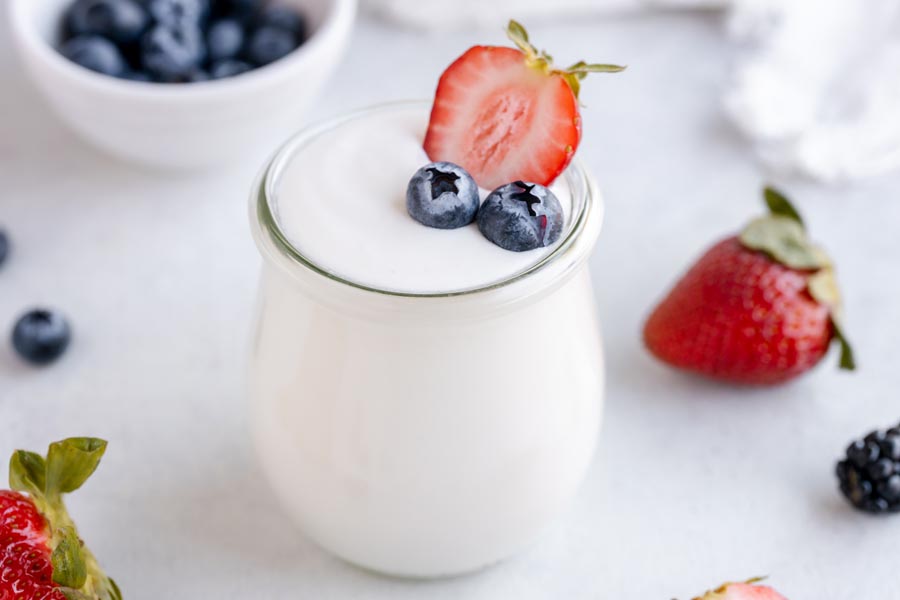
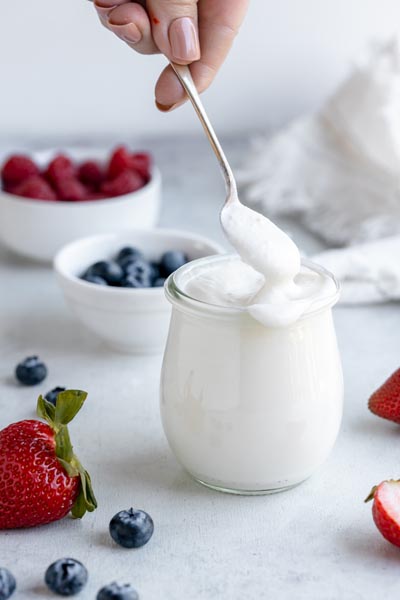
A small jar of homemade yogurt topped with berries and a bowl of blueberries to the rear.

What surprised me most is how forgiving the whole process is. You heat milk, let it cool, stir in a spoonful of starter, and walk away for 8 hours. The Instant Pot holds everything at the right temperature while you sleep. I give instructions below for making it without the yogurt button, too.

  • For a high-fat version, use all or half heavy whipping cream. Each 5 oz serving jumps to 346 calories and 32 grams fat. I make this version when I want something thick and custard-like.
  • For a lower calorie version, use all ultra-filtered milk. Each 5 oz serving drops to 96 calories and 5.1 grams of fat. This is what I batch for weekday breakfasts.

I use the plain base in all sorts of other recipes, from yogurt fruit dip to avocado smoothie bowls. It’s also great eaten straight with a handful of berries.

One thing I learned from a reader (DanO, in the comments below) changed how I think about the heating step. Heating to 180 degrees isn’t about killing bacteria. The pasteurization already handled that. The real purpose is to denature the milk proteins, which is what gives you that thick, spoonable texture instead of a thin, runny mess. I’d been repeating the bacteria explanation for years before he corrected me.

Reader Matt has made eight batches and found that bumping the starter to a half cup of Siggi’s cuts incubation from 8 hours to about 6. He also confirmed what I’ve seen in my own kitchen: if the milk is still at 120 degrees when you add cultures, the texture never fully sets. That 110-112 sweet spot matters more than any other step in this recipe.

KetoFocus fans have the best tips

” Homemade yogurt is the best. In my pre-keto days I made a French yogurt in my pressure cooker that was drop dead delicious. If you have one with the Yogurt button there’s no need to wait to add the cultures. Whisk the milk, cream & starter together & set the timer for 8 hours & walk away. If you want to, you can make it using the “pot-in-pot” method by pouring it into individual mini Mason jars, popping the lids on & stacking them inside the liner. After the 8 hours, let them cool down then pop them into the fridge. Great for grab & go.

➤ from YouTube subscriber @jerritanner275


How to make homemade yogurt

  1. Gently warm the milk to 180 degrees Fahrenheit. This step denatures the milk proteins, which is what creates that thick, spoonable texture (not bacteria killing, as I used to think). Add ultra-filtered milk and heavy whipping cream to the liner, then press the ‘yogurt’ button. If your Instant Pot doesn’t have a yogurt button: press ‘keep warm’ for 40-45 minutes, then press ‘saute’ and heat until a thermometer reads 180 degrees.
    • Some yogurt makers say you can skip heating with ultra-pasteurized milk. I cover the cold start method in the FAQ section below.
  2. Let cool to 110-112 degrees. Remove the liner and place on a cooling rack. Do not let it drop below 110, or the cultures won’t activate properly. I’ve made that mistake, and you end up with thin liquid that never sets. Reader Yuki found that an ice bath gets it there in about 10 minutes instead of the hour it takes on the counter.
  3. Add yogurt starter and incubate. Whisk in about 1/4 cup of plain yogurt with live cultures, replace the lid, and press ‘yogurt’ again. The Instant Pot holds the right temperature for 8 hours. Without a yogurt button, wrap the pot in a towel or sleeping bag and leave it at room temperature for 8 hours.
  4. Refrigerate. Scoop into Mason jars and store in the fridge. The yogurt thickens more as it cools.

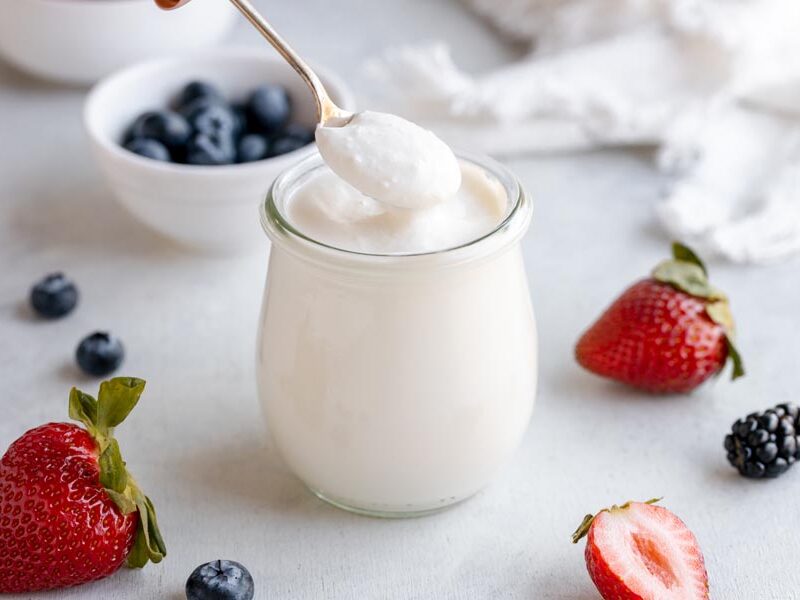
A hand holding a spoonful of white yogurt in front of the jar of yogurt. Some of the yogurt is spilling down the edge of the glass.

Key ingredients

  • Ultra-filtered whole milk – I use Fairlife specifically. Ultra-filtered milk has most of the sugars and lactose removed, which keeps carbs down. Make sure it’s ultra-pasteurized so you’re starting with clean milk that won’t introduce bad bacteria during incubation.
  • Heavy whipping cream – About 0.3 grams of carbs per tablespoon. I use ultra-pasteurized cream. Mixing it with the milk gives you a richer, creamier result with fewer carbs than an all-milk batch.
  • Plain yogurt with live cultures – This is your starter. Check the label for ‘live active cultures’ or ‘live probiotics.’ I’ve used Two Good and Siggi’s as starters, and both work. Reader Matt swears by a half cup of Siggi’s for faster incubation.


Equipment needed

Youtube
640K+ subscribers
Discover More Keto Recipes on Our Channel

Explore 685+ keto recipe videos with step-by-step instructions, tips, and tricks to make keto easy.

Recipe
Print Pin

Keto Yogurt

4.6 (5) Prep 5m Cook 30m Total 35m 13 servings

Keto Yogurt Ingredients

Flavored Yogurt (5-6 Oz Serving) Ingredients

Step by Step Instructions

Step by Step Instructions

1
Gently heat milk

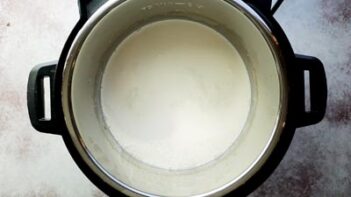
Add 32 oz ultra-filtered, ultra pasteurized whole milk and 32 oz of ultra pasteurized heavy whipping cream to the liner of an instant pot. (For a lower calorie, lower fat option, use 64 oz whole milk only.) Put the lid on and seal closed. Instant Pot with Yogurt Button: Press the ‘yogurt’ button. Instant pot will slowly heat the milk up to 180 degrees. If your Instant Pot doesn’t have a Yogurt Button: Press the ‘keep warm’ and heat milk for 40-45 minutes. Remove the lid and press ‘sauté’. Insert a candy thermometer and heat milk until it reaches 180 degrees F.

Looking down an Instant Pot with simmering milk inside.
Tip Heating the milk to 180 degrees Fahrenheit will kill any lingering bad bacteria.
Ingredients for this step
  • 32-64 oz whole milk
  • 32 oz heavy whipping cream (optional)
2
Let cool

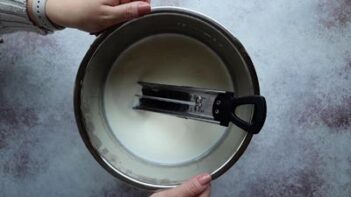
Remove the liner from the instant pot and place on cooling rack or pad to cool. Let milk cool to 110-112 degrees. DO NOT let the temperature drop passed 110 degrees or else your yogurt cultures may not grow.

Holding the liner of an Instant Pot with a thermometer inside.
Tip If a film develops on top of the yogurt, you can skim it off.
3
Add active cultures

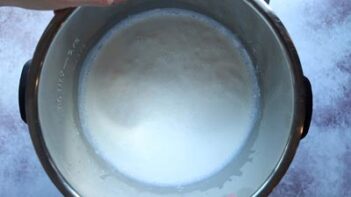
Once the milk temperature has lowered to 112 degrees, whisk in the yogurt. Replace the lid. Instant Pot with Yogurt Button: Press the “yogurt” button. The Instant Pot will maintain the ideal temperature for incubation. If your Instant Pot doesn’t have a Yogurt Button: Turn off the Instant Pot. Wrap the Instant Pot with a large beach towel or sleeping bag to help insulate and let sit at room temperature for 8 hours. Insulating the pressure cooker, will help to keep it at the ideal temperature to allow the yogurt to grow.

Looking into the liner of an instant pot with a yogurt culture growing.
Ingredients for this step
  • 1/4 cup yogurt
4
Refrigerate

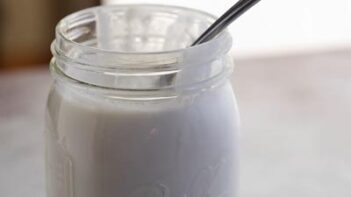
Once the yogurt is done incubating, scoop into Mason jars and store in the refrigerator. The yogurt will continue to thicken as it cools.

A mason jar with yogurt and a spoon sticking out.
Tip If there is thinner liquid on top of the yogurt mixture, you can either pour it off to yield a thicker yogurt or stir it into the mixture to make a thinner yogurt.
5
Make flavored keto yogurt

To make flavored yogurt, portion out 5-6 oz of yogurt in a small bowl. Stir in powdered sweetener, flavoring extract and 1-2 drops of food coloring (if using).

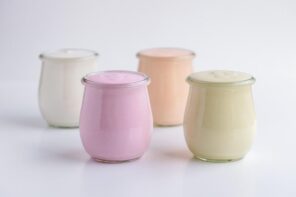
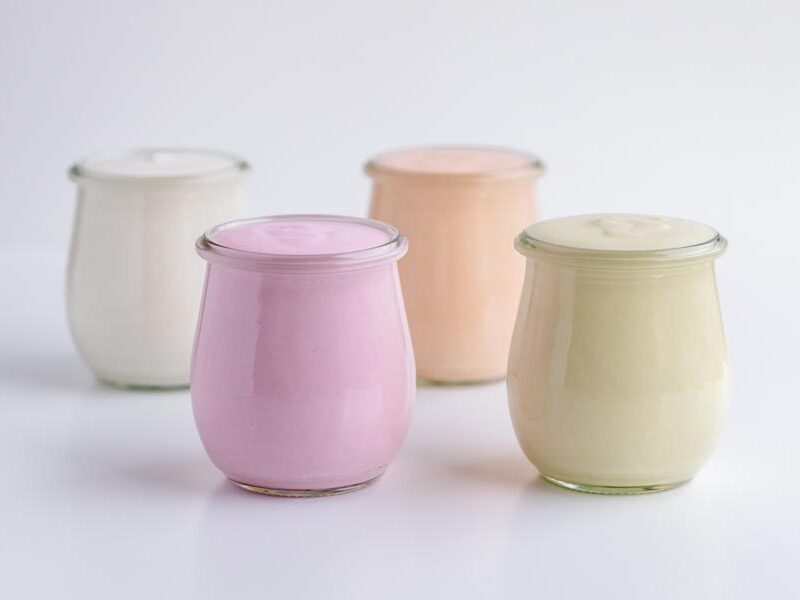
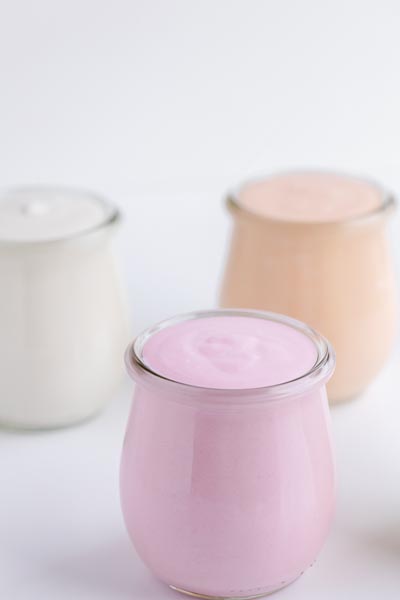
Flour yogurt flavors next to each other in glass jars.
Ingredients for this step
  • 1/2 teaspoon powdered sugar-free sweetener
  • 1/4 teaspoon flavoring extract
  • food coloring (optional)
Nutrition Per Serving 5 oz
346 Calories
32.2g Fat
5.7g Protein
3.5g Net Carbs
3.5g Total Carbs
13 Servings
Nutrition disclaimer

The nutrition information provided is an estimate and is for informational purposes only. I am a Doctor of Pharmacy (Pharm.D.); however, this content is not intended to be a substitute for professional medical advice, diagnosis, or treatment. Always consult your physician or other qualified health provider before making any lifestyle changes or beginning a new nutrition program.

Your Macros. Your Recipes. Calculated in 60 Seconds.

Get personalized keto macros and instantly see which recipes fit your targets. No more guessing what to eat.

Get My Macros + Recipes →

Get weekly keto recipes from Annie.

Join the list and get new recipes delivered to your inbox every week.

Keto Yogurt

Frequently Asked Questions

Can I have yogurt on keto?

Yes, but read labels carefully. Most yogurt at the store is loaded with added sugars or made from skim milk, which drives the carbs up. I keep Two Good or Ratio on hand for busy weeks, but my go-to is making my own batch. Homemade gives me full control over what goes in, and at 3.5 g carbs per 5 oz serving, it fits easily into my daily macros.

Can I make Greek yogurt by straining it?

I've done this with several batches and it works perfectly. Once the yogurt is done incubating and chilled, I line a fine mesh strainer with cheesecloth, pour the yogurt in, and let it drain in the fridge for 4-6 hours. The whey drips through and you're left with a much thicker, creamier result. Straining closer to 6 hours gives me a texture almost like cream cheese, which I love on its own or as a base for dips.

What is the cold start method for making yogurt?

Cold start means skipping the heating-to-180 step entirely. You mix ultra-pasteurized milk with the starter culture and go straight to incubation. I've tried it a few times and it works, but the texture comes out noticeably thinner because you're skipping the protein denaturing step. If thick, spoonable yogurt is what you're after, I still recommend heating first.

Why didn't my yogurt set?

The most common reason (and I've made this mistake myself) is adding the starter culture when the milk is still too hot. Anything above 115 degrees can kill the live cultures before they do their job. My thermometer is non-negotiable for this step. Other culprits: starter yogurt that doesn't actually have live cultures (check the label), or the Instant Pot losing temperature during incubation. Wrapping the pot in a towel helps if you don't have the yogurt button.

Does longer incubation make yogurt tangier or just firmer?

Both, in my experience. I've tested 6, 8, 10, and 12 hour incubation times. Past 8 hours, the tang increases noticeably as the cultures continue converting lactose to lactic acid. Texture firms up slightly too, but the flavor shift is the bigger change. I prefer 8 hours for a mild, creamy result. If you like that sharp Greek-style tang, try 10-12 hours and see where your preference lands.

Can I make this with all heavy whipping cream?

Yes, and it's incredible. I make the all-cream version when I want something dense and custard-like. Each 5 oz serving comes to about 346 calories and 32 grams of fat, so it's rich. I treat it more like a dessert base than breakfast yogurt. For a lighter batch, I use all ultra-filtered milk instead, which drops each serving to 96 calories and 5.1 g fat.

What can I do with the liquid whey on top?

That thin liquid is whey, and I used to pour it off without thinking. Now I save it. I stir it into smoothies for extra protein, use it as the liquid in my souffle pancakes, or just mix it back into the yogurt for a thinner consistency. You can also freeze it in ice cube trays and toss a cube into shakes later.

Browse by Ingredient
Similar Recipes

Others looking for “Keto Yogurt” also liked:

Creamy keto yogurt in a jar topped with berries and berries scattered around.

Best low carb yogurts at the store

Most yogurt at the store is packed with sugar, either from added sweeteners or skim milk. I’ve tried just about every ‘low sugar’ brand on the shelf, and a few are worth keeping in rotation.

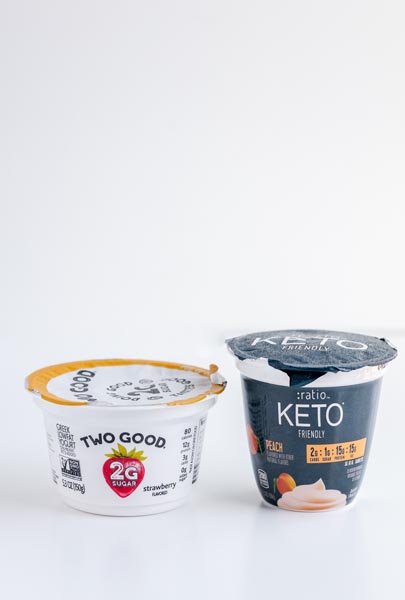
  • Ratio Keto Friendly Yogurt – Only 2 g carbs per 5 oz container with 15 g protein and 15 g fat. I’ve tried most of the flavors and the coconut is the only one I’d buy again. The others taste slightly off to me.
  • Two Good – My favorite store-bought brand. 3 g carbs per container and the flavor range is solid (strawberry, vanilla, lemon, blueberry, and more). I use the plain one in recipes when I don’t have a homemade batch ready.
  • CarbMaster – A Kroger brand at about 5 g carbs per serving. It does contain sucralose and acesulfame potassium, which some people prefer to avoid.
  • Chobani Zero Sugar – 5 g carbs per serving. I’ve had the vanilla and blueberry. Both are fine but not something I’d pick over Two Good.
  • Oikos Triple Zero – Around 7 g carbs with 15 g protein. Higher carb than I’d like for daily use, but solid if you need the extra protein.
  • Kite Hill – Dairy-free, made from almonds. 6 g carbs per serving. I haven’t used this one much myself, but readers who are dairy-free have recommended it.
  • Plain Greek Yogurt – In a pinch, grab the lowest carb Greek yogurt you can find. They range from 5-10 g carbs per serving depending on brand.
Two yogurt brands are side by side. One is a container of Two Good yogurt. The other is Ratio Keto Friendly Yogurt.

How to flavor your yogurt

This is the part I look forward to. Once you have the plain base, you can portion out a jar and turn it into whatever flavor sounds good that day. I keep powdered sweetener (monkfruit or erythritol, the kind that measures cup-for-cup with powdered sugar) and a few flavor extracts in the pantry for exactly this.

You can also stir in sugar-free fruit syrups. I blend a handful of frozen strawberries with a little sweetener and mix it right in. Way better than anything that comes pre-flavored from the store.

Here are the ratios I use for a 5 oz portion:

  • Peach – 1/2 teaspoon powdered sugar-free sweetener, 1/4 teaspoon peach flavoring, 2 drops orange food coloring.
  • Vanilla – 1/2 teaspoon powdered sugar-free sweetener and 1/4 teaspoon vanilla extract.
  • Strawberry – 1/2 teaspoon powdered sugar-free sweetener, 1/4 teaspoon strawberry flavoring, 2 drops red food coloring.
  • Lemon – 1/2 teaspoon powdered sugar-free sweetener, 1/4 teaspoon lemon flavoring, 2 drops yellow food coloring.

Choosing your yogurt starter

You need a yogurt starter to get the fermentation going. It’s just a culture of live bacteria that converts milk into yogurt. I’ve used two approaches and both work well:

  • Plain yogurt with active cultures – This is what I use most often. Just 1/4 cup of plain yogurt whisked into the cooled milk. Make sure the label says ‘live active cultures’ or ‘live probiotics.’ I’ve had good results with both Two Good and Siggi’s as starters.
  • Heirloom starters – These come as freeze-dried powder from specialty retailers. The upside is they last forever in the freezer. Some require lower incubation temperatures than the Instant Pot provides, so check the package instructions before buying. You can also use a spoonful of yogurt from someone who started with an heirloom culture.
Three jars of yogurt. One is pink and the two in the back are white and orange.

Making yogurt without an Instant Pot

Not everyone has an Instant Pot, and that’s fine. I’ve gotten some great methods from readers who use different equipment.

A YouTube subscriber, Cynthia, makes hers in a food dehydrator:

“I take a new quart of ultra pasteurized half-and-half. I add a dollop of yogurt (it has to have fresh live cultures) to it and stir. You don’t have to have a yogurt maker – I have put it in a bowl and covered it with plastic and put it in my dehydrator at 104 degrees F.”

Another subscriber, Jenny, uses the stovetop method her grandparents taught her:

“One can just heat up milk in a stainless steel pot on the stove, to around 180 degrees F. (to get rid of unwanted bacteria…) Then pour it into a CLEAN ceramic crock and let the milk cool to 110 degrees F and then add your glob of starter yogurt. (This of course can be saved from your previous batch) I put on the ceramic lid, wrap the container in towels, and put it in a cabinet overnight. This is how my grandparents did it, I almost never purchase yogurt… Only if my starter has died.”

Jenny also uses this method for homemade kefir:

“Homemade kefir is even easier, it’s basically the same method but you don’t have to heat up the milk. And you have to use kefir grains instead of yogurt. It’s a highly stinky food though, so I think that most people will pass on it lol but once you get used to the flavor… Your gut will thank you.”

Dairy free yogurt variation

I’ve made this with full-fat coconut milk and it works well. Just swap the milk and cream for 1 quart of full-fat coconut milk or coconut cream and add your starter culture. Follow the same Instant Pot instructions from the recipe card.

The result is a thick, creamy, low carb coconut yogurt that’s completely dairy free. The coconut flavor is noticeable but not overpowering. I like it with a little vanilla extract stirred in.

Recipes that use homemade yogurt

Besides eating it straight or as a parfait, I use homemade yogurt in a lot of my other recipes. Here are some favorites:

How to store homemade yogurt

I store mine in the refrigerator and it stays good for about 2 weeks. The flavor gets tangier as it sits because the cultures keep working slowly, even in the cold. I actually prefer the taste around day 4-5 when it has a little more bite.

You can also freeze it. I use airtight Mason jars and freeze for up to a month. The texture changes slightly after thawing (a bit grainier), but stirring it well brings it back close to normal. Frozen yogurt works great blended into smoothies even if the texture isn’t perfect for eating with a spoon.

About the Author
Annie Lampella, Pharm.D.

Annie Lampella, Pharm.D.

Annie is a Doctor of Pharmacy, mom, and the recipe creator behind KetoFocus. With a B.S. in Genetics from UC Davis, she has over 14 years of experience developing family-friendly keto recipes based on the science of human metabolism.

More Breakfast Recipes

A slice of high protein french toast casserole on a plate covered with sugar-free maple syrup and topped with raspberries, blueberries and strawberries.
60 Mins
High Protein French Toast Casserole
4.9 Stars (11 Reviews)

25 grams of protein and only 4.4g net carbs per serving. This high protein french toast casserole has crispy edges, a custardy cinnamon center, and I...

See the Recipe
a fork cut into the yolk of an egg cup
15 Mins
Keto Egg Cups
4.9 Stars (14 Reviews)

Three ingredients, 15 minutes, and breakfast is handled for the week. I meal prep these low-carb egg cups every Sunday and my kids grab them straight...

See the Recipe
close up original keto chaffle
6 Mins
Keto Chaffle Waffle
5 Stars (83 Reviews)

I add almond flour and baking powder to a basic cheese-and-egg chaffle so it actually tastes like a waffle, not a cheesy omelet. Four ingredients,...

See the Recipe
danishes on a gray plate topped with white icing drizzle
30 Mins
Keto Cream Cheese Danish
4.8 Stars (18 Reviews)

I make this cream cheese danish when I want a real pastry with my morning coffee. Light, airy meringue-based dough with a sweet cheesecake filling,...

See the Recipe
breakfast carnivore waffles
6 Mins
Keto Carnivore Waffle
4.7 Stars (24 Reviews)

The paffle is my carnivore version of a waffle, made with just egg, cheese, and pork rinds. I make these almost every morning when I'm doing...

See the Recipe
creamy strawberry chia pudding in little jars
5 Mins
Strawberries and Cream Keto Chia Pudding
4.9 Stars (34 Reviews)

This strawberries and cream chia pudding is my favorite keto breakfast when I need a break from eggs. Blend it up in minutes or let it set overnight...

See the Recipe
Reviews 18
4.6 Stars (5 Reviews)
  1. T
    Taylor Apr 7, 2026

    I've been making yogurt with a sous vide circulator for years, since holding exact temp through full incubation makes a real difference in texture, and I want to try it with ultra-filtered milk. The 112-degree target for adding cultures is the same either way. What I can't figure out: does the Instant Pot's yogurt mode do anything beyond holding temp for those 8 hours? Would a water bath at 112 get the same result, or does the Instant Pot environment matter somehow?

  2. M
    Mike Harris Apr 4, 2026

    I don't have an Instant Pot, just a slow cooker. Would the 8-hour incubation work in there, or does it need that keep-warm setting?

  3. B
    Brian Mar 31, 2026

    Ok so one thing that changed everything for me: get an instant-read thermometer and do not guess on the 112 degree step. First two batches I went by feel and the yogurt came out thin and loose, barely thicker than the milk I started with. Third time I used my Thermapen, hit 112 on the dot, and it set up thick enough that I had to scoop it out of the liner, not pour it (which is the whole point). Also discovered that using the Instant Pot's actual 'Yogurt' function instead of just 'Keep Warm' holds the incubation temp way more consistently across the full 8 hours. That's what finally locked in the texture. Four stars because I'm still dialing in the Lakanto powdered ratio to get the sweetness where I want it, but the base method is legit. Running a batch every Sunday now.

    1. Annie Lampella
      Annie Lampella Apr 4, 2026

      Yogurt function is what I use too. Keep Warm dips too low mid-incubation, I noticed it on my third batch. For the Lakanto, start at 3 tablespoons and taste before it chills, sweetness dulls a bit cold.

  4. M
    Melissa Mar 16, 2026

    My grandma made yogurt from scratch every week and I figured that was just one of those things I'd accepted losing on keto. Three ingredients and an Instant Pot later and I'm sitting here crying a little. I don't know what I expected but it wasn't this.

    1. Annie Lampella
      Annie Lampella Mar 18, 2026

      Your grandma would be proud. I start mine before bed every Sunday so it's ready when I wake up. Eight hours goes fast when you're not watching it.

  5. P
    Paul S. Mar 9, 2026

    First batch turned out thicker than anything from the store, no straining needed. Already planning a second. One question: does pushing incubation past 8 hours make it tangier, or does it mostly just firm up?

    1. Annie Lampella
      Annie Lampella Mar 10, 2026

      Both, but the tang is the bigger shift. I've pushed it to 10 and 12 hours and the flavor gets noticeably sharper each time. Texture firms up a little too, but if you're after that punchy Greek-style bite, go to 10.

  6. R
    Rebecca Davis Mar 7, 2026

    I've made this eight times and the heavy cream version ruins every store-bought option permanently.

    1. Annie Lampella
      Annie Lampella Mar 9, 2026

      Yeah going back to store-bought after the all-cream version is basically impossible. I treat mine more like dessert at this point.

  7. Y
    Yuki M. Mar 2, 2026

    First time making homemade yogurt and I genuinely did not expect it to work. The Instant Pot handled the incubation fine, but I was caught off guard by how long the milk takes to cool to 112 degrees (took close to an hour on my counter). Once I figured out an ice bath gets it there in about 10 minutes, the whole thing felt way more doable. Yogurt came out creamy and thicker than I expected, which was a nice surprise. Only tip: start with less flavoring extract than you think you need. I overdid it the first time and it tasted artificial, but easy to dial in once you know.

    1. Annie Lampella
      Annie Lampella Mar 3, 2026

      The ice bath is the right call. Counter cooling I stopped bothering with years ago, it's just slow. And yes, light hand on the extract, especially vanilla, it gets artificial fast.

  8. M
    Matt Feb 26, 2026

    Batch eight now, and I've settled into a version that works pretty consistently. Main thing I changed is bumping the culture to closer to a half cup (I use Siggi's plain as the starter) and it sets in about 6 hours instead of 8, which matters when you're starting it Sunday morning and want it ready before dinner. The heavy cream version is what I do when making it for myself, whole milk only when I'm stretching a bigger batch for the week. Either way, the 112 degree step is the thing I underestimated at first. Tried to rush it once when it was still at 120 and the texture never really set right. Cold mornings in February and there's always a jar in the fridge now.

    1. Annie Lampella
      Annie Lampella Mar 1, 2026

      The 120 degree thing catches everyone once. That loose texture that never fully sets no matter how long you refrigerate it. Half cup of Siggi's getting you to 6 hours is interesting - I might test that.

  9. K
    Kim Feb 18, 2026

    I had no idea homemade yogurt was this easy to make. Honestly thought it was one of those things that required special equipment or a ton of babysitting, but I just used my Instant Pot and it worked. The texture came out so thick and creamy, way better than the store stuff I've been buying. Already planning to try the strawberry flavoring next time.

    1. Annie Lampella
      Annie Lampella Feb 18, 2026

      The strawberry one is so good. I blend a handful of frozen strawberries with a little sweetener and mix it right in - way better than anything store-bought flavored yogurt.

  10. D
    DanO Dec 31, 2024

    The reason you heat the milk and hold at 180 is not to kill bacteria - that was done in the pasteurization process. It is to denature and break down the milk proteins which allows for a thicker, more set, yogurt texture. Absolutely necessary for thick, smooth, spoonable consistency.

    1. Annie Lampella
      Annie Lampella Jan 4, 2025

      OK this finally makes it click for me!! I'd been repeating the 'kill bacteria' explanation for years and never questioned it. The protein breakdown piece is what I was missing.

Leave a Review