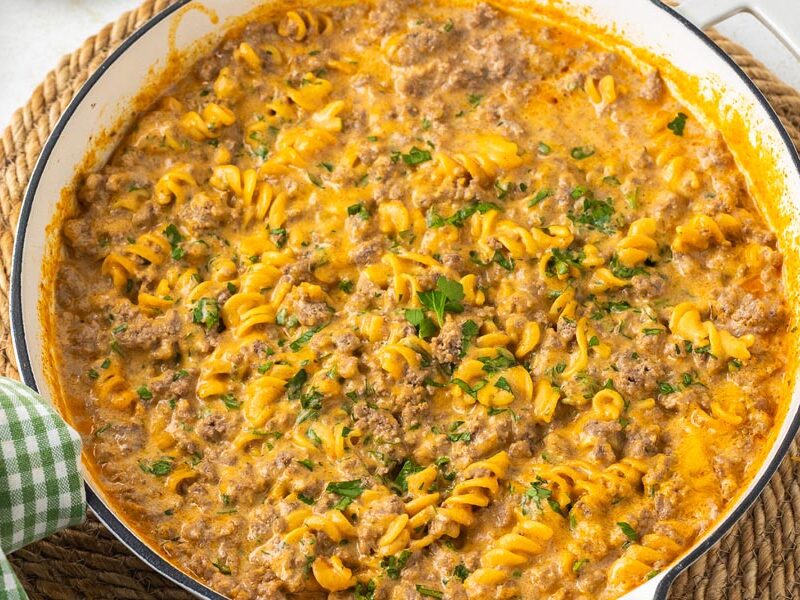
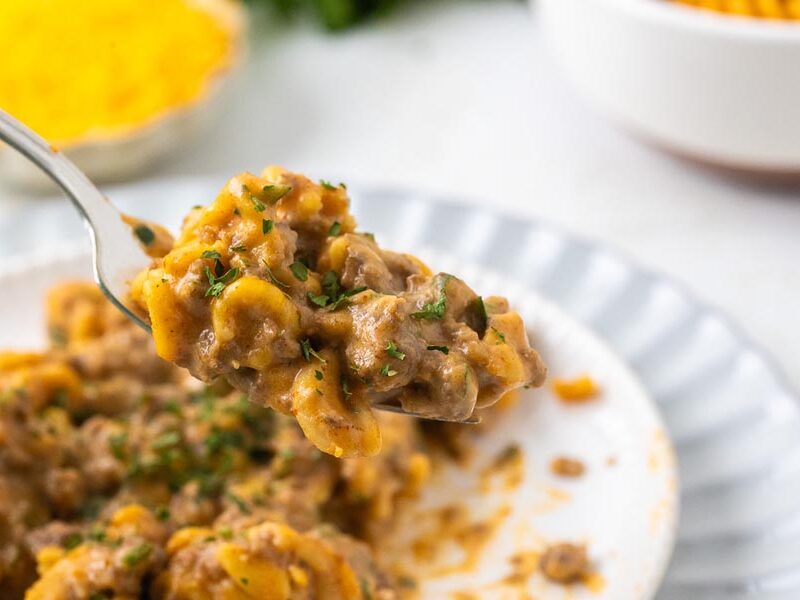
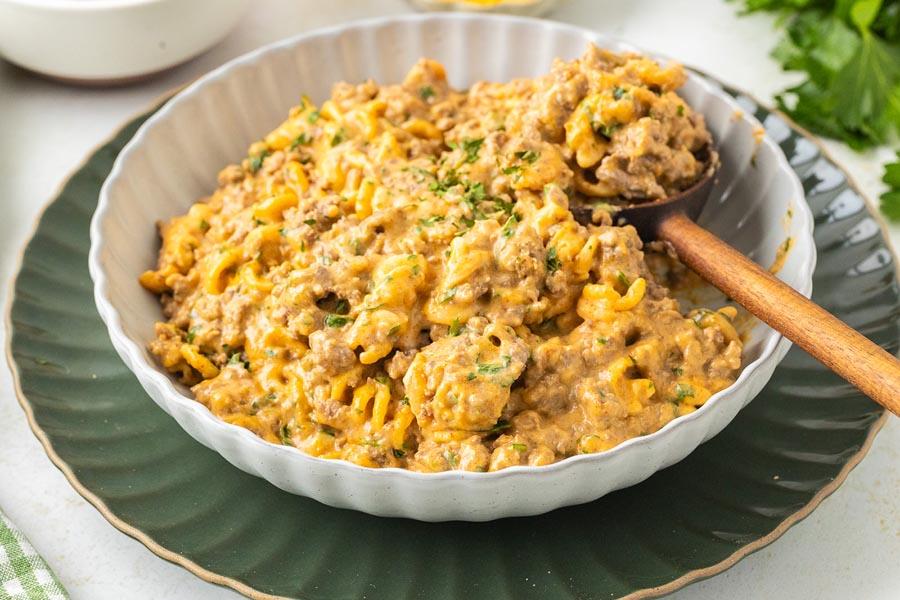
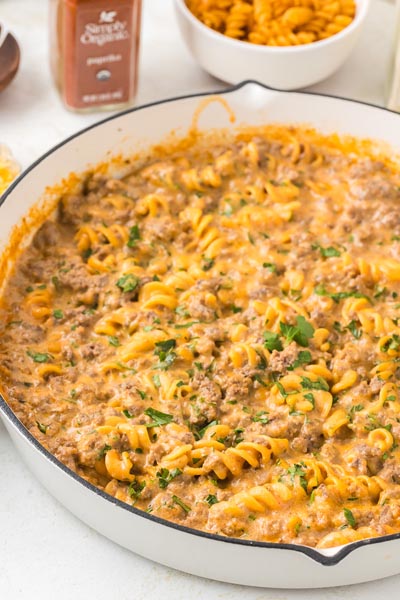
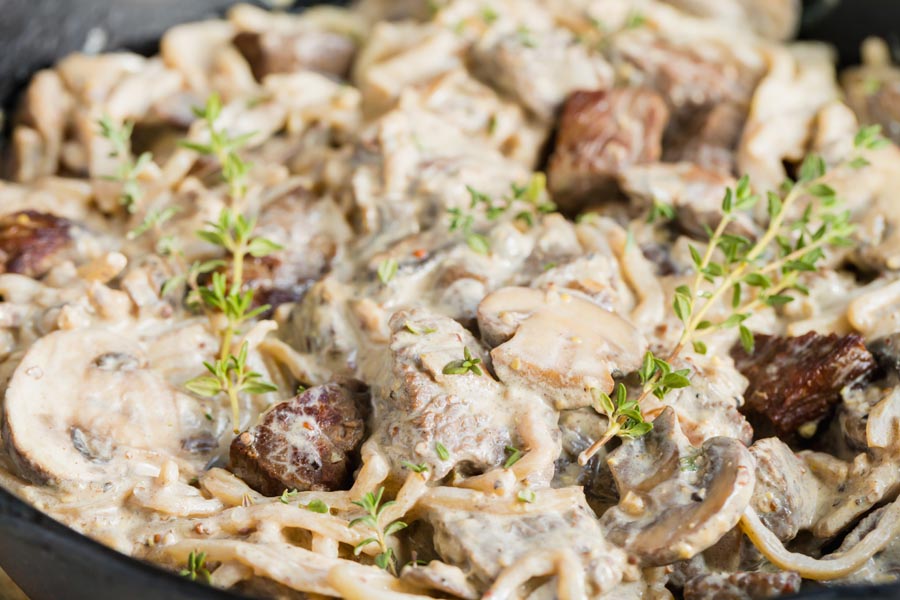
Keto hamburger helper, beefy and creamy like the boxed favorite I grew up on, at 5.7g net carbs and 47.6g protein per bowl. I brown the beef, simmer the lupini pasta right in the seasoned milk, and I let the skillet cool a minute or two before the cheddar stirs in, which is what keeps the sauce smooth instead of grainy.
Hamburger Helper was like an elevated mac and cheese for me as a kid. We had it at least once a week, and I never complained. Now that I'm the one cooking dinner on a Tuesday night with 20 minutes to spare, I finally understand why my mom reached for that box so often. But the original runs about 29g net carbs per serving, mostly from enriched pasta and the thickeners hiding in that seasoning packet. I'm not feeding my family that, so I built my own.
This one pot keto hamburger helper is what I make when I want something warm, cheesy, and done fast. Ground beef, sharp cheddar, a handful of spices I already have in my cabinet, and lupini pasta. One skillet, about 17 minutes, 47g protein per serving. I've made this more times than I can count, and it hits the same nostalgia as the boxed kind without the carb crash afterward.
What makes this homemade version different
The spice blend is real The original seasoning packet relies on maltodextrin, modified food starch, and a list of fillers you'd need a chemistry degree to decode. I use paprika, garlic powder, onion powder, salt, and pepper. That's the actual backbone of the original flavor, minus everything I can't identify. A tablespoon of arrowroot thickens the sauce (cornstarch works too, but I've found arrowroot gives me better timing with the pasta).
Lupini pasta that soaks up the sauce I use lupini pasta because it holds its shape in a cheese sauce and doesn't leak water the way shirataki does. I've tested five different low carb pasta swaps in this specific dish and ranked them. Lupini wins by a wide margin for sauce cling and texture.
Budget-friendly protein Ground beef is one of the most affordable proteins I buy. Combined with the cheese and pasta, this feeds my whole family for a fraction of what a steak dinner costs.
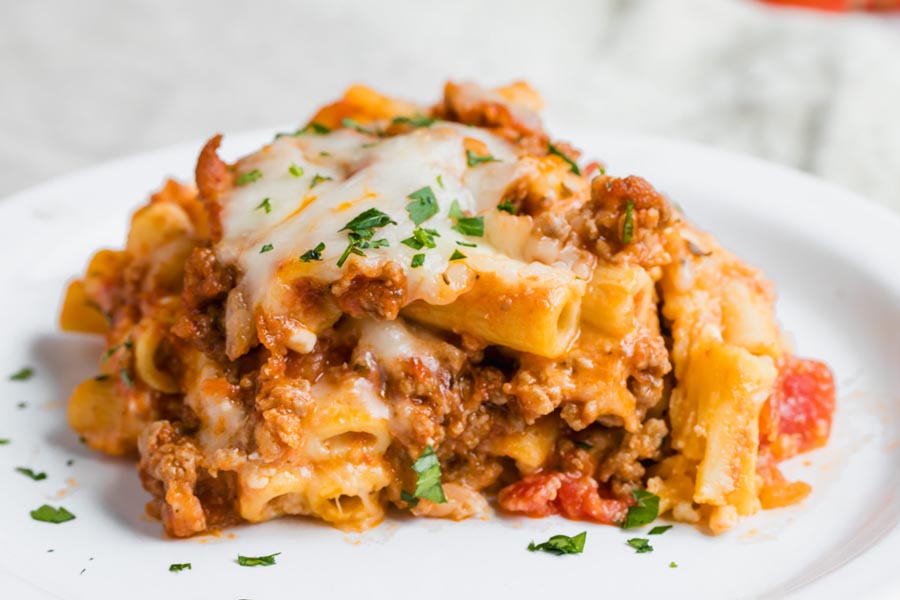
If you love this kind of comfort food, try my keto spaghetti, Tuscan chicken pasta, and skillet lasagna next. I rotate all of them throughout the week when I need dinners that don't require me to think too hard. My baked ziti is another good one if you want the same cheesy, one-dish energy. And when I skip the skillet and go full burger night, my juicy lucy burgers with molten cheese sealed inside are the family pick.
What I love most about this recipe is how forgiving it is. I've accidentally let it simmer an extra two minutes and the pasta was still fine. I've swapped in different cheeses depending on what was open in the fridge. The one technique that matters: pull the pan completely off heat and wait a full 90 seconds before adding the cheese. It clings to the pasta instead of pooling at the bottom. I do this instinctively now, but once I timed it, 90 seconds was the sweet spot.
Low carb pasta swaps I've actually tested
I get it, lupini noodles aren’t always easy to find. I’ve tested this recipe with several alternatives, and here’s what I’d reach for:
Hearts of palm noodles My second choice after lupini. I grab the spaghetti shape or buy the lasagna sheets and cut them into smaller pieces. They’re gluten-free with barely any carbs, and the texture holds up well in a cheese sauce like this.
Shirataki noodles Not my favorite, but the ziti shape works better here than spaghetti. Rinse them well and dry them in the skillet for a minute before adding the sauce. I rank these lower because shirataki leaks water into the sauce, which is exactly why so many other versions of this dish end up thin and broken.
Egg wraps You can make your own or grab the Egglife brand at the store. I cut them into strips and toss them in at the end. In a cheesy sauce like this, they taste surprisingly close to real noodles.
Cauliflower rice When I can’t find any keto pasta, cauliflower rice gets the job done. It turns this into more of a ground beef skillet, but the flavor is still there.
How to store and freeze leftovers
I always make extra because this reheats well. Store leftovers in an airtight container in the refrigerator for up to 4 days. When I reheat it, I warm it on the stovetop over low heat and add a splash of broth or milk to loosen the sauce (it thickens a lot overnight).
For freezing, I portion it into individual containers and freeze for up to 2 months. I add a little extra sauce or broth before sealing because the pasta absorbs liquid as it sits. To reheat from frozen, I thaw it in the fridge overnight and warm it on the stovetop. The texture holds up better than I expected. For batch cooking nights, I’ll double this and freeze half alongside my shepherd’s pie. Both reheat well and cover two completely different weeknight moods.
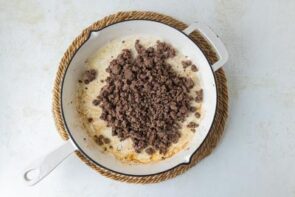
Place ground beef in a large skillet and brown over medium-high heat, then drain and return to the skillet.
For this step
1 lb lean ground beef
2
Season and pasta it
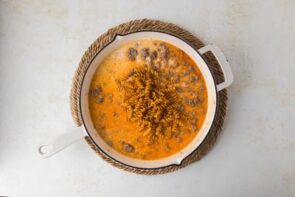
Stir in arrowroot powder or cornstarch, paprika, garlic powder, onion powder, salt, pepper, hot water, milk of choice and lupini pasta. Bring the liquid to a simmer. Reduce heat to medium, cover and simmer until pasta is al dente, stirring occasionally, about 4-5 minutes.
For this step
1 tablespoon arrowroot powder or cornstarch
2 teaspoons paprika
1 teaspoon garlic powder
1 teaspoon onion powder
1 teaspoon salt
1/4 teaspoon black pepper
1 cup hot water
2 cups milk of choice
1 1/2 cups lupini pasta
3
Make it cheesy
Turn off the heat and let the skillet cool for a minute or two, then add cheddar cheese. Stir until smooth and creamy. Let stand for 5 minutes or until the sauce thickens.
For this step
1 cup shredded sharp cheddar cheese
Nutrition
Per serving: 1 bowl
Calories
473
Fat
24.3g
Protein
47.6g
Total carbs
19.1g
Net carbs
5.7g
Nutrition is an estimate calculated from the ingredients listed. Brands vary, so check labels if you track closely.
Frequently Asked Questions
Does this reheat well for meal prep and lunches?
I meal prep this almost every week. It reheats better than most pasta dishes because the lupini pasta doesn't get mushy overnight. I store individual portions in glass containers, and when I'm ready to eat, I warm it on the stovetop over low heat with a splash of broth or almond milk to thin the sauce back out. Straight from the fridge, the sauce firms up into almost a solid block, but 30 seconds of stirring over low heat brings it right back. I've taken this to work in a thermos and it held up fine for four hours.
How do I keep the cheese sauce from breaking or getting grainy?
This was my biggest problem when I first started making this. The fix is simple: pull the pan completely off heat and wait a full 90 seconds before adding the cheese. If the pan is too hot, the cheese seizes up and gets grainy instead of melting smoothly. I also grate my own cheese off the block instead of using pre-shredded. The anti-caking powder in bagged cheese makes the sauce slightly gritty. I figured this out after four or five batches where the sauce looked perfect and then broke the second I added the cheese.
What can I use instead of lupini pasta?
I've tested this with hearts of palm noodles, shirataki ziti, egg wraps cut into strips, and cauliflower rice. My favorite swap is hearts of palm because the texture is closest to real pasta in a cheese sauce. Shirataki works but it leaks water into the sauce, which is why so many other versions of this dish end up thin. I keep a few bags of lupini pasta stocked now, but any of those will work if you can't find it.
Can I use ground turkey instead of ground beef?
I've made this with ground turkey and it works fine, but the flavor is milder. When I use turkey, I add an extra pinch of paprika and a splash of Worcestershire to make up for the richness you lose without beef fat. Ground chicken works too, same adjustments. Brown either one all the way to 165 degrees before the liquid goes in, since ground poultry needs to hit that temperature. If I'm in a turkey mood for something with more spice, I usually make my taco casserole instead.
How do I make this dairy-free?
I've tested this with unsweetened almond milk in place of regular milk and it works well. For the cheese, I use a dairy-free cheddar shred (I like the Violife brand). The sauce won't be quite as creamy, but my friend who's dairy-free said it was the closest thing to the real version she'd had in years.
What's the difference between arrowroot and cornstarch as a thickener here?
I've used both and prefer arrowroot for this recipe. Cornstarch thickens faster, which sounds like a good thing, but in practice it means the sauce sets up before the lupini pasta is fully cooked. I'd pull the lid off and the sauce was already thick while the pasta still had bite. Arrowroot is slower and more forgiving. It gives me an extra minute or two of cook time before the sauce locks in, which is exactly the window I need for the pasta to finish. If you only have cornstarch, use it, but watch the timing closely and stir more often.
Can I add bacon to this?
I've done this and my family lost their minds over it. I cook 3-4 strips of bacon first, crumble them, and set them aside. Then I use the bacon fat to brown the ground beef instead of draining it. Stir the crumbled bacon back in at the end with the cheese. It adds another layer that turns this into more of a cheeseburger skillet. Same beef-and-cheese energy as my Philly cheesesteak casserole, just in a different form.
Can I add vegetables to this recipe?
I throw in whatever I have on hand sometimes. Broccoli florets, diced bell peppers, and sliced mushrooms all work well. I saute them with the ground beef so they soften before the sauce goes in. My kids don't love visible vegetables, so I dice everything small and they don't even notice.
Is Hamburger Helper high in carbs?
Yes. The boxed version runs about 29g net carbs per serving, mostly from enriched pasta and the thickeners in the seasoning packet. My homemade keto version lands at 5.7g net carbs and 19.1g total carbs per bowl. The difference comes from swapping the enriched pasta for lupini pasta and replacing the packet with paprika, garlic powder, onion powder, salt, and pepper. You keep the flavor and get 47.6g of protein per serving instead of the carb load.
Can I make keto hamburger helper with cabbage?
Yes, cabbage works. Slice it thin and saute it with the ground beef until it softens, then build the sauce in the same skillet. It turns this into more of a cheeseburger skillet than a pasta dish, the same thing that happens with the cauliflower rice swap. The beef, cheddar, and spice blend still carry it. I reach for lupini pasta first because nothing else holds the cheese sauce as well, but cabbage is a solid option when it's what you have.
Double the paprika, the base runs a little neutral as written. Boxed dinner food was the keto thing I hadn’t found a fix for until now, and this actually works. Annie, that one was overdue.
I swapped the hot water for beef broth and the sauce got this richness I wasn’t expecting, the cheddar has something to grab onto now instead of just coating everything, and the whole thing tastes like you actually meant for it to taste that way. Use low sodium though. I didn’t the first time and oversalted it because the seasoning blend already has real salt and I forgot to account for that. Making this again this week as I have most weeks.
Got my wife’s whole side of the family coming this weekend, like 12 people, so I need to at least triple this. Do I just multiply everything straight across or does the arrowroot powder need tweaking? Thickeners can get weird when you scale up.
Rick, start with 2.5x the arrowroot and see where the sauce lands before adding more. I’ve done straight math on the starch when scaling up a thickened sauce before and it got gluey fast. Everything else multiplies straight across.
I found everything except lupini pasta, nowhere near me carries it. Would shirataki noodles work, or do they fall apart in a sauce like this? Still figuring out which keto pasta swaps actually hold up.
Shirataki holds up fine in this sauce, won’t fall apart. Rinse them well and dry them in a hot skillet for a couple minutes first or they’ll water the cheese sauce down. If you ever spot hearts of palm noodles, April, I’d try those instead. They hold up way better in a cheese sauce.
I cook a lot but lupini pasta is new to me. Does it need to be pre-cooked first, or does it cook through in the sauce with the hot water and milk? Because one pan would be way simpler than I expected.
There’s something about the paprika and garlic powder in this that I completely forgot existed as a combination smell. My mom made the box kind on weeknights through most of my childhood, and going keto I just quietly crossed it off the list of things I’d ever eat again. Standing at the stove waiting for the arrowroot to pull the sauce together, that smell came back and I genuinely had to stop for a second. The lupini pasta was the thing I was most unsure about, but it holds the sauce and actually works. Nothing gummy, nothing falling apart. Made a second batch four days later, which probably tells you everything. Did not see this one coming.
That smell is what I was chasing. My mom made the box kind on weeknights too, so I spent a long time on the spice ratio before I’d let myself move on to anything else. Four days later tells me it landed.
Good catch, Lakshmi. The arrowroot contracts when it cools and the sauce goes from silky to thick pretty fast. Milk works better than water here, keeps it creamy.
Used cornstarch instead of arrowroot (it’s what I had) and it worked fine. Just give it a full minute after adding the lupini pasta or the sauce stays too thin.
Pulled this off the heat a full minute before adding the cheese and the sauce came out so much silkier than my first attempt. Also swapped the milk for half unsweetened almond milk, half heavy cream and it thickened up beautifully with the arrowroot. Won’t make it any other way now.
Somewhere around batch seven now and I keep thinking about the way the lupini pasta absorbs that cheese sauce. It gets this creamy bite that regular pasta just does not give you, and I noticed it on batch two and have not stopped since. Spring weeknight staple at this point.
I kept waiting for the lupini pasta to betray me and it never did. Sauce coats everything, genuinely creamy, and honestly better than the boxed stuff I grew up on.
Swapped the milk for half heavy cream, half chicken broth because I was running low and didn’t feel like making a store run. The sauce came out noticeably thicker than the original, and it coats the lupini pasta in a way that made every bite feel heavier (in the best sense). I wasn’t expecting much of a difference but it was pretty obvious from the first spoonful. Made a double batch, which I almost never do on a first try, and it reheated the next day without any of that grainy separation you sometimes get with cream sauces. Going to stick with this version.
I held off for months because lupini pasta has burned me before (that aftertaste when it’s not rinsed well enough). Finally made it on a weeknight when I had ground beef to use up. Completely changed my mind. The sauce comes together fast and the arrowroot really does give you that thick, clingy coating that makes hamburger helper feel like hamburger helper. Let it sit off the heat for about 5 minutes before serving and it tightened up even more. 47g of protein per serving for a pasta dish is kind of absurd in the best way. Making it again this week.
Three years is a long time to go without hamburger helper. The arrowroot took me a few tries to nail down too, cornstarch kept thickening before the pasta was ready.
The sauce came together so fast with the arrowroot I thought I messed something up. It actually tastes like the boxed version I grew up on, which I did not expect. Does this reheat well for lunches?
Hi Mei, it reheats really well. I warm mine on the stovetop over low heat with a splash of milk or broth to loosen the sauce, since it thickens up in the fridge.
Made this on a cold Tuesday when nobody wanted anything complicated. My husband (who grew up eating the actual box stuff) took one bite and said “this tastes more like the real thing than the real thing.” That kind of comment you don’t fish for. The lupini pasta held up better than I expected, sauce clung to it evenly, no mushiness. Keeping this in the weeknight lineup.