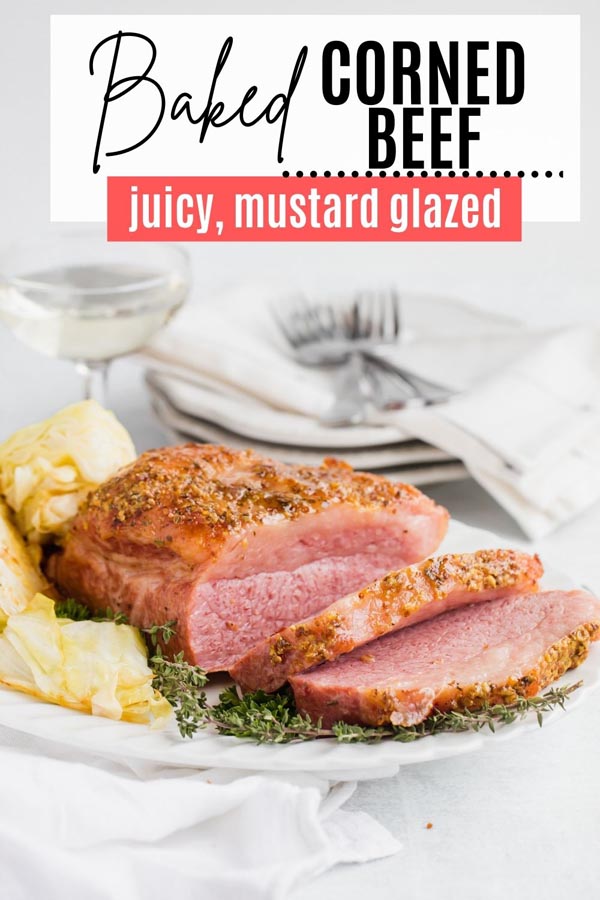
Baked Corned Beef

Published March 1, 2021 • Updated February 25, 2026
This post may contain affiliate links. See my disclosure policy.
This oven-braised corned beef and cabbage uses just 5 ingredients. I braise the brisket in dry white wine for 3 hours, then finish it with a sugar-free maple Dijon glaze under the broiler for a caramelized, fork-tender result with only 0.4g net carbs per serving.
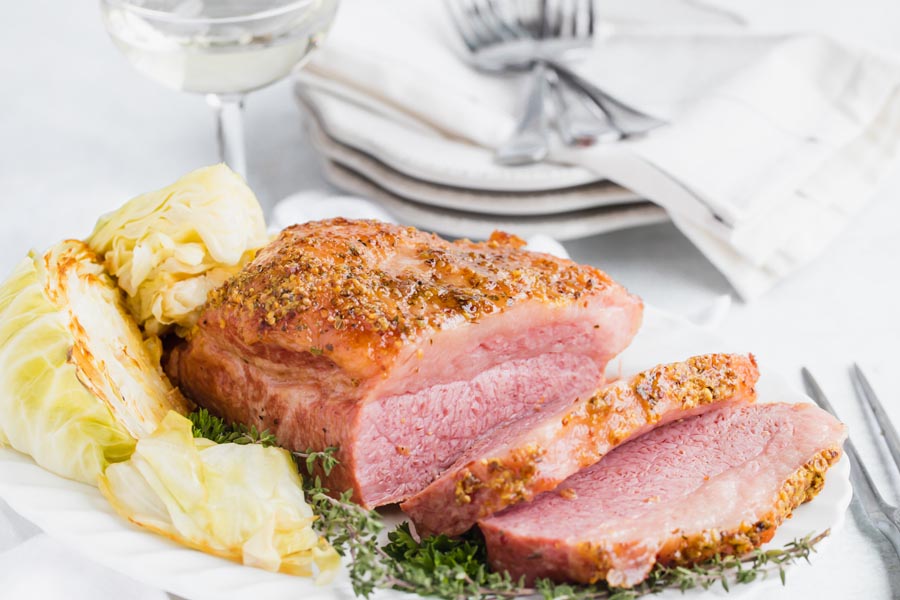
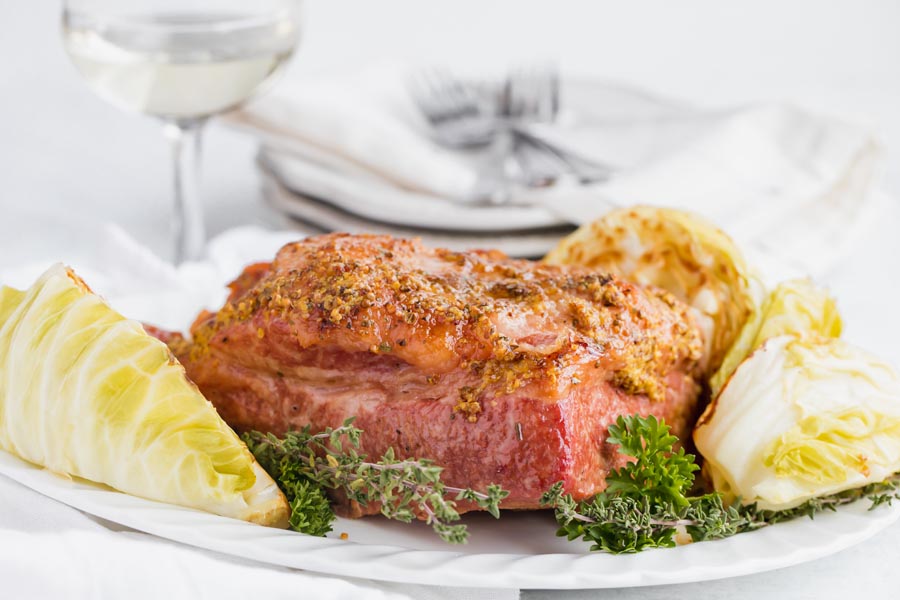
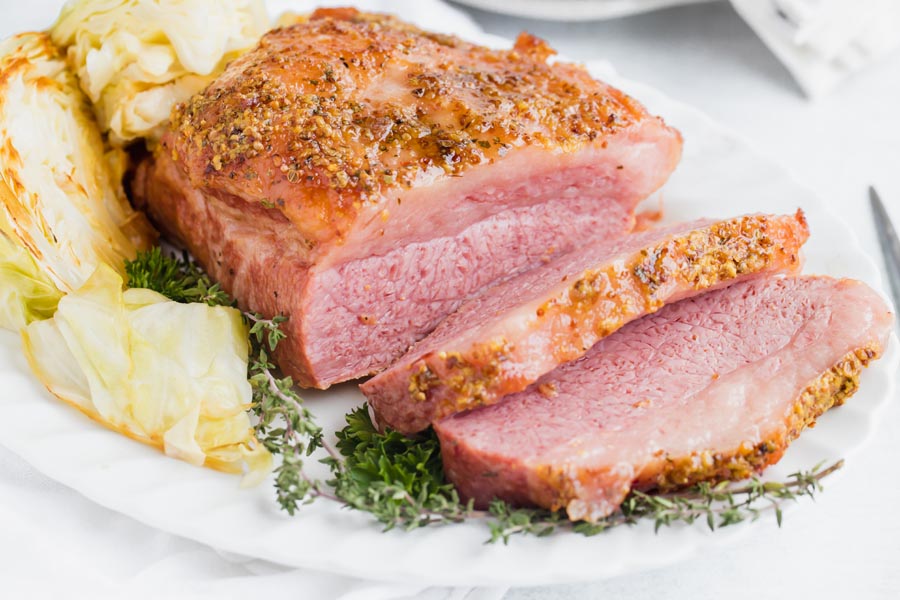
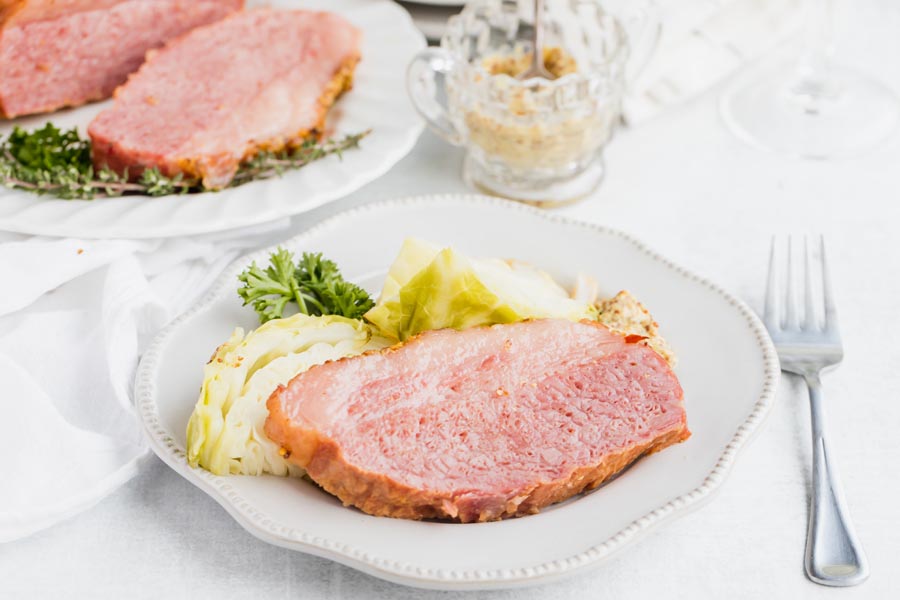
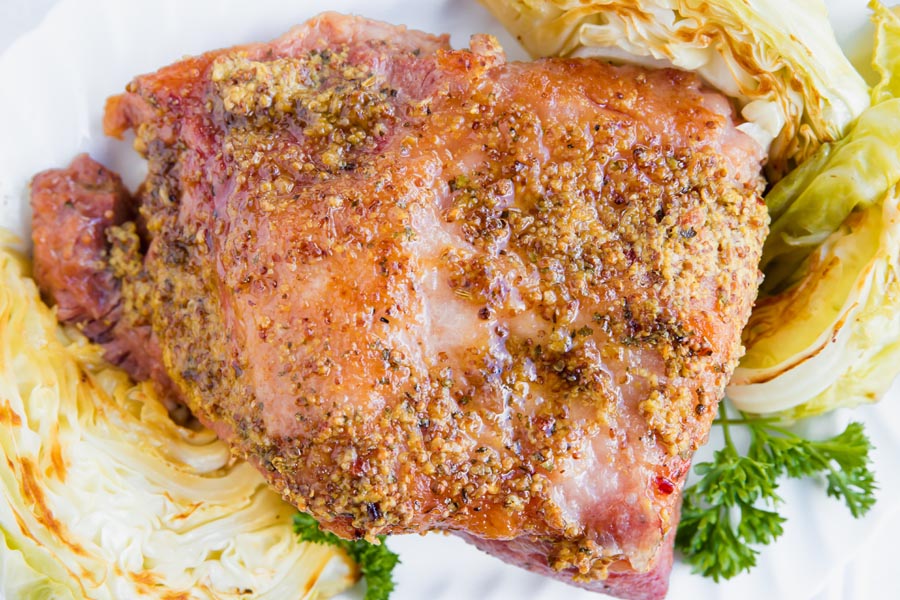
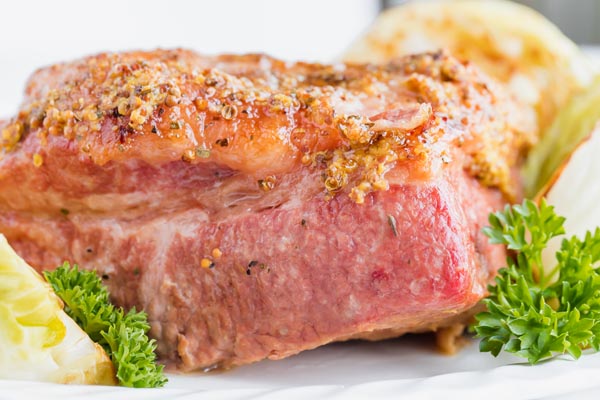
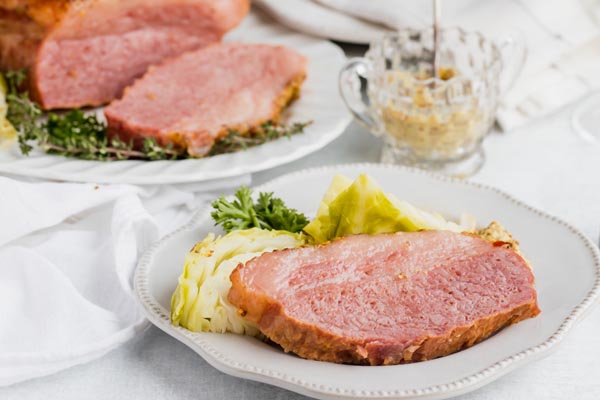
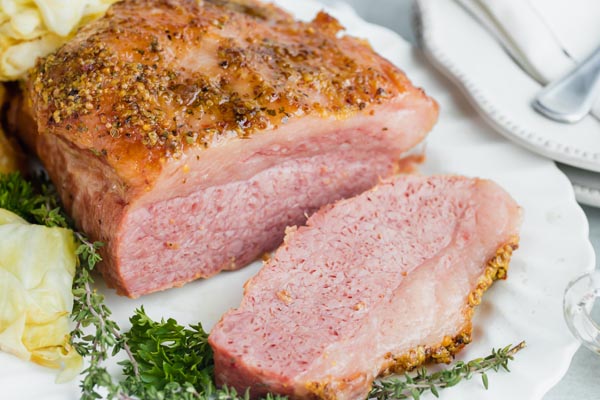
I have been making this baked corned beef every March for years, and I still look forward to it every single time. The method is simple: braise a corned beef brisket in dry white wine at 325 degrees for about 3 hours, toss cabbage wedges in for the last 30 minutes, then brush on a sugar-free maple Dijon glaze and broil until the top caramelizes. That crispy, sweet-salty crust over fork-tender meat is what makes this version stand out.
I use just 5 ingredients for the whole thing. The brisket comes with its own spice packet (peppercorns, mustard seeds, bay leaves, coriander), and between that and the wine braise, every bite has serious depth. The glaze is two ingredients: sugar-free maple syrup and grainy mustard. That is it. If you are looking for more 5-ingredient keto recipes, I have a whole collection.
The cabbage cooks right in the braising liquid, so it soaks up all those beef and wine juices. I never bother with a separate side because the cabbage basically seasons itself. If you want something crunchy alongside, my keto coleslaw pairs perfectly, or try homemade keto sauerkraut for a tangy contrast.
I always go with the flat cut for cleaner slices, though the point cut works if you prefer more marbling. Either way, I rinse the brisket, pat it dry, and place it fat cap up in my Dutch oven with a cup of dry white wine. I have used Sauvignon Blanc, Chardonnay, and Pinot Grigio, and they all work. The wine’s acidity helps break down the tough connective tissue, so you end up with incredibly tender meat after about an hour per pound.
This is one of my favorite keto dinner recipes because it feeds a crowd with almost zero effort. I pull the brisket at 195 degrees for fall-apart texture, let it rest for 20 to 30 minutes, and slice against the grain. At 0.4g net carbs per serving, it fits any low-carb plan without compromise.
If you love beef dinners as much as I do, check out my 66 keto beef recipes for more ideas. My keto beef stew uses a similar low-and-slow braise, and my keto beef and broccoli is great for weeknight dinners when you want something faster.

Explore 685+ keto recipe videos with step-by-step instructions, tips, and tricks to make keto easy.
Ingredients
 3 lb flat cut, corned beef brisket with spice packet
 -
1 cup dry white wine
-
1/2 head of cabbage, cut into four wedges
-
3 tablespoons Dijon mustard
-
1 tablespoon sugar free maple syrup, optional
Step by Step Instructions
Step by Step Instructions

Rinse and Pat Dry Corned Beef
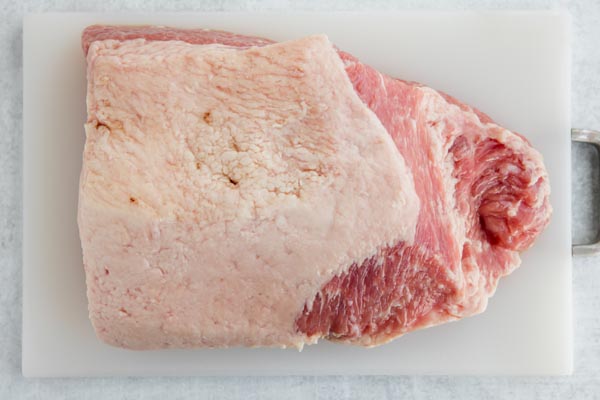
Remove corned beef from package and reserve spice packet. Rinse off corned beef brisket and pat dry with a paper towel.

Add corned beef to a Dutch oven
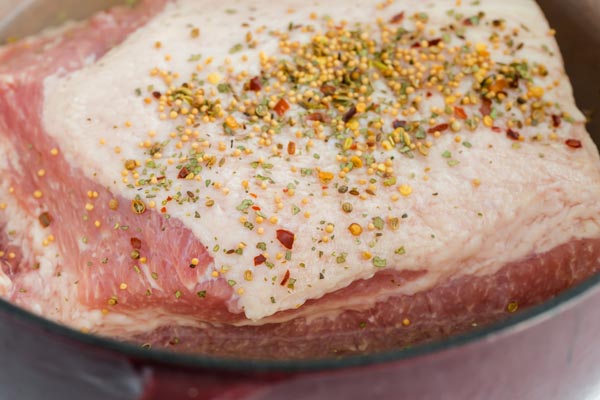
Add corned beef brisket, fat cap side up, to a large Dutch oven. Pour in wine. Sprinkle contents of spice packet on top of corned beef. Cover and place in a 325 degree oven to braise for 3 hours. After a couple of hours, check on the corned beef to make sure there is enough liquid in the pot. If needed, add 1/2 cup more wine, chicken broth or water.

Add cabbage
Remove Dutch oven and place the cabbage wedges around the corned beef. Cover and cook for another 30 minutes.

Add the maple dijon glaze
In a small bowl, combine Dijon mustard and sugar free maple syrup. Remove the Dutch oven from the oven. Set aside the cabbage wedges. Brush the maple Dijon glaze over the top and sides of corned beef.


Nutrition disclaimer
The nutrition information provided is an estimate and is for informational purposes only. I am a Doctor of Pharmacy (Pharm.D.); however, this content is not intended to be a substitute for professional medical advice, diagnosis, or treatment. Always consult your physician or other qualified health provider before making any lifestyle changes or beginning a new nutrition program.
Your Macros. Your Recipes. Calculated in 60 Seconds.
Get personalized keto macros and instantly see which recipes fit your targets. No more guessing what to eat.
Get My Macros + Recipes →Frequently Asked Questions
Can I use a different cut of corned beef for baking?
I usually go with the flat cut because it gives me cleaner, more uniform slices. The point cut has more fat marbled through it, so it comes out richer and more flavorful, but it does not slice as neatly. I have made this recipe with both, and the cook time stays about the same. If you go with the point cut, just know it will shred more than slice.
What can I substitute for dry white wine in the braise?
I have only tested this with white wine (Sauvignon Blanc and Chardonnay both worked great for me), but if you do not cook with alcohol, low-sodium beef broth is your best bet. I would add a splash of apple cider vinegar to the broth for some of that acidity that helps tenderize the meat. A reader asked about red wine, and I think a Burgundy or Chianti would add a deeper, richer flavor. I have not tested it myself yet, but it is on my list.
Can I make this corned beef in a slow cooker or Instant Pot?
I have not tested this exact recipe in a slow cooker or Instant Pot, so I cannot give you exact times. The oven braise method is my preferred approach because you get that caramelized glaze under the broiler at the end, which you would miss with a slow cooker. If you do try it in a crockpot, I would estimate 8 to 10 hours on low. Just save the glaze step for the oven at the very end.
How do I know when corned beef is done?
I always use an instant-read thermometer. For fall-apart tender meat (my preference), I pull it at 195 degrees. If you want sliceable but still tender, 180 degrees works. I have overcooked it once by going past 200 degrees, and it got a bit dry, so the thermometer is key. Plan about 1 hour per pound at 325 degrees.
Do I need to rinse corned beef before cooking?
I always rinse mine. The brine leaves a lot of surface salt, and rinsing gives you a more balanced flavor. If your brisket tastes really salty when you unwrap it, I soak it in cold water for 30 minutes. But if you like saltier meat, skip the rinse. I have made it both ways and honestly both are good, it just depends on your taste.
Is baked corned beef keto-friendly?
This is one of my favorite keto meals because corned beef has zero carbs on its own. My recipe comes in at just 0.4g net carbs per serving, and that tiny amount is from the cabbage. The glaze uses sugar-free maple syrup instead of brown sugar, so there is no added sugar. I make this regularly as part of my low-carb routine.
Can I skip the sugar-free maple syrup in the glaze?
I would not skip it, personally. The sweetness from the sugar-free maple syrup is what balances the salty, spiced meat and creates that caramelized crust under the broiler. Without it, the glaze is just mustard, and you lose that sweet-salty contrast. If you do not have sugar-free maple syrup, I would try a few drops of liquid stevia or a pinch of granulated sweetener mixed into the mustard.
What can I make with leftover corned beef?
I always make extra on purpose. Leftover corned beef is incredible sliced thin and reheated in a skillet for a low-carb Reuben wrap with sauerkraut and mustard. I have also diced it up for a corned beef hash with diced radishes instead of potatoes. Leftovers keep in an airtight container in the fridge for 3 to 4 days, or I freeze portions for up to 2 months.




I've made corned beef probably six times since going keto, always the slow cooker version. It's always fine, but the texture goes mushy and the flavor just sits there. The maple Dijon glaze and that broiler finish changed that. You get this caramelized crust on the fat cap you can't get from braising alone.
Made this a few days after St. Patrick's Day because the corned beef was still on sale. Honestly, timing worked out fine. The maple Dijon glaze under the broiler at the end is the part I keep thinking about (going on pork next). My one note: the cabbage was pretty mushy by the time everything was done. I'd probably add it in the last 45 minutes next time instead of the full braise. But the brisket itself was falling apart tender and the house smelled like something my grandmother used to make.
Used a dry Sauvignon Blanc I had open and the braising liquid reduced into this glossy, slightly savory pool that I kept spooning back over the meat during the last hour. Next time I'm starting with a cup and a half instead of one.
One tweak worth sharing: I stirred a teaspoon of whole grain mustard into the maple Dijon glaze and the extra tang it adds under the broiler is SO good. Also pulled the cabbage wedges out at the 2-hour mark instead of letting them go the full 3, and they held their shape way better while still soaking up all that white wine.
The 2-hour cabbage pull is worth flagging. Full 3 hours and mine gets soft enough it basically loses the wedge shape. Whole grain mustard in the glaze is interesting too, the seeds would char a little under the broiler. Trying that.
I've made corned beef maybe a dozen ways over the years (slow cooker, Instant Pot, that weird beer-and-onion situation I tried once) and this is the first time I've gotten genuinely fork-tender results without the meat going gray and dull. The dry white wine surprised me. Kept the liquid tasting clean the whole braise, not murky the way beer or broth can get. The maple Dijon glaze under the broiler is what separates this from every other version I've tried. Pulled it out and the top had this lacquered, caramelized crust that looked almost too good to slice into. Four stars only because I slightly over-reduced my pan liquid before the cabbage went in and had to add a splash of water to recover. Entirely my fault for not watching it, but worth mentioning if you're used to the slow cooker set-it-and-forget-it approach.
The liquid creeps on you. I keep about half an inch before the cabbage goes in. Once you go white wine, broth just tastes muddy.
Beginner tip that made a difference: let the Dijon glaze sit on the meat for a couple minutes before broiling instead of going straight in. Mine came out with this deeper caramelized color I wasn't expecting from just mustard and sugar-free maple syrup. St. Patrick's Day is sorted.
Good call. Letting it set a minute means it actually grips instead of sliding off into the pan. That's where the deeper color comes from.
Corned beef has always seemed like one of those things I'd mess up, so I've defaulted to deli slices for years. Tried this last weekend because I finally had a Dutch oven and wanted to actually use it. Three hours at 325 and it was already pulling apart before I even touched it with a fork. The maple Dijon glaze under the broiler was the part I was dreading most, but a few minutes in and it came out with this sticky, caramelized crust I wasn't expecting. First time making brisket and it looked exactly like the photos. The 0.4g net carbs still doesn't fully make sense to me, but I'm very much okay with that.
Ha, the 0.4g is just from the cabbage wedges. Brisket on its own has zero carbs. And that glaze gets that sticky crust in about 3-4 minutes under the broiler, faster than it looks like it will.
Served this for St. Patrick's Day dinner and the broiler step is what got everyone talking. The maple Dijon glaze turns into this dark, lacquered crust that looks nothing like what most people expect from corned beef. My brother-in-law, who treats everything at the table like an obstacle, had cleaned his plate before I finished the sides. The wine braise keeps it from drying out even at three hours, which I was nervous about the first time.
Ha, the reluctant brother-in-law clearing his plate. Three hours always feels like too long but the wine braise really does protect it.
Made a big batch on Sunday and portioned it out for the week. One tip: let it cool completely before slicing. I cut into it too soon the first time and it fell apart. Once it sat overnight in the braising liquid, the slices came out clean and held together for reheating all week. That maple Dijon glaze does way more to keep it from drying out than I expected.
Overnight rest matters. I slice mine cold now. That glaze surprised me on the reheating side too.
This is by far the most delish corned beef recipe I've ever made!! My neighbor (whose father in law is FROM Ireland) told me "this was the BEST corned beef I've ever eaten--No Kidding!" My only change was to make my own "maple" slurry from granulated stevia, water and a touch of corn starch/ maple extract. Otherwise EXACTLY as instructed. I was skeptical of the wine, it absolutely MAKES the mustard sauce!! Thank you so much
Ha, if her father-in-law is from Ireland and he called it the best he's ever had, that's the only endorsement this recipe needs. Your stevia slurry swap is smart. The cornstarch probably helps it cling before broiling.
WOW, great taste. I cooked a 4.5 lbs roast yesterday/Sunday, upped the wine to 1 1/2 cups, and extended cook time slightly. Really wonderful beef and Cabbage (personally not a big fan of boiled cabbage). Side dishes of boiled potatoes and carrots (for non-keto eaters). I loved this so much, and wife agreed, that I'm heading out to buy another roast for later this week (17th). I have questions if I might; 1) Can we use red wine, I only had 1 bottle of white left and plenty of Burgundy & Chianti, but used the Riesling, as you suggested. Other White varietals you've tried and liked? 2) Any info on pressure cooker or sous vide cooking options for this, and in line- is there a recommended internal meat temp to reach? Thanks much, heading out for more items on some of your other recipes as well. {Can't find daikon radishes yet} LOL,
I haven't tried it with red wine but I think it would add a nice flavor too. I've used a Chardonnay and a Sauvignon Blanc. Both were delicious! I haven't tried this recipe in the pressure cooker or sous vide. It should work. You would just have to look up directions on how to do it.